Scientists believe the biodegradable device could someday help detect multiple saliva biomarkers. If true, it might provide a new type of test for clinical laboratories
When it comes to tongue depressors, it turns out you can teach an old dog new tricks. Researchers from National and Kapodistrian University of Athens Greece (NKUA) have taken this simple wooden medical tool and developed a high-tech biosensing device that may someday be useful at the point-of-care in hospitals and as a new type of test for clinical laboratories.
Using diode laser engraving, the researchers developed an “eco-friendly disposable sensor that can measure glucose levels and other biomarkers in saliva,” according to LabMedica.
This proof-of-principle biosensing device demonstrates the feasibility of “simultaneous determination of glucose and nitrite in artificial saliva,” according to the NKUA scientists who hope it will help doctors diagnose a variety of conditions.
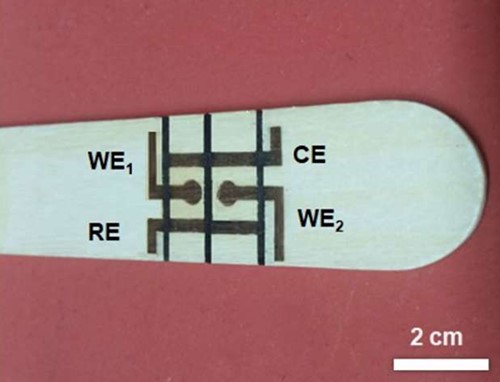
In their published paper, the scientists at the University of Athens wrote that their wooden electrochemical biosensing tongue depressor (above) “is an easy-to-fabricate disposable point-of-care chip with a wide scope of applicability to other bioassays,” and that “it paves the way for the low-cost and straightforward production of wooden electrochemical platforms.” Might this and other similar biosensing devices eventually find their way to clinical laboratories for use in identifying and tracking certain biomarkers for disease? (Photo copyright: University of Athens.)
How to Make a High-Tech Tongue Depressor
Though wood is affordable and accessible, it doesn’t conduct electricity very well. The researchers’ first attempt to solve this problem was to use the wood as “a passive substrate” to which they coated “metals and carbon-based inks,” LabMedica reported. After that they tried using high-powered lasers to “char specific regions on the wood, turning those spots into conductive graphite.” But that process was complicated, expensive, and a fire hazard.
The researchers eventually turned to “low-power diode lasers” which have been used successfully “to make polyimide-based sensors but have not previously been applied to wooden electronics and electrochemical sensors,” LabMedica noted.
In their Analytical Chemistry paper, the researchers wrote, “A low-cost laser engraver, equipped with a low-power (0.5 W) diode laser, programmably irradiates the surface of the WTD [wooden tongue depressor], forming two mini electrochemical cells (e-cells). The two e-cells consist of four graphite electrodes: two working electrodes, a common counter, and a common reference electrode. The two e-cells are spatially separated via programmable pen-plotting, using a commercial hydrophobic marker pen.”
In other words, the researchers “used a portable, low-cost laser engraver to create a pattern of conductive graphite electrodes on a wooden tongue depressor, without the need for special conditions. Those electrodes formed two electrochemical cells separated by lines drawn with a water-repellent permanent marker,” states a press release from the American Chemical Society.
“The biosensor was then used to quickly and simultaneously measure nitrite and glucose concentrations in artificial saliva. Nitrite can indicate oral diseases like periodontitis, while glucose can serve as a diagnostic for diabetes. The researchers suggest that these low-cost devices could be adapted to detect other saliva biomarkers and could be easily and rapidly produced on-site at medical facilities,” LabMedica reported.
Benefits of Using Wood
One of the major benefits of using wood for their biosensing device is how environmentally friendly it is. “Since wood is a renewable, biodegradable naturally occurring material, the development of conductive patterns on wood substrates is a new and innovative chapter in sustainable electronics and sensors,” the researchers wrote in Analytical Chemistry.
Additionally, the tongue depressor features “An easy-to-fabricate disposable point-of-care chip with a wide scope of applicability to other bioassays, while it paves the way for the low-cost and straightforward production of wooden electrochemical platforms,” the researchers added.
This adds to a growing trend of developing bioassay products that keep the health of our planet in mind.
“This new BC test is non-toxic, naturally biodegradable and both inexpensive and scalable to mass production, currently costing less than $4.00 per test to produce. Its cellulose fibers do not require the chemicals used to manufacture paper, and the test is almost entirely biodegradable,” a UPenn blog post noted.
New Future Tool Use in Clinical Diagnostics
Who could have predicted that the lowly wooden tongue depressor would go high tech with technology that uses lasers to convert it to an electrochemical multiplex biosensing device for oral fluid analysis? This is yet another example of technologies cleverly applied to classic devices that enable them to deliver useful diagnostic information about patients.
And while a biosensing tongue depressor is certainly a diagnostic tool that may be useful for nurses and physicians in clinic and hospital settings, with further technology advancements, it could someday be used to collect specimens that measure more than glucose and nitrites.
Many clinical laboratory professionals are aware of the significant amount of waste going into landfills from spent COVID-19 rapid PCR tests that use biosensors to produce results. These biosensor systems “use printed circuit boards, or PCBs, the same materials used in computers. PCBs are difficult to recycle and slow to biodegrade, using large amounts of metal, plastic, and non-eco-friendly materials,” according to a Penn Engineering Today blog post.
UPenn’s new test does not use PCBs. Instead, its biosensor uses “bacterial cellulose (BC), an organic compound synthesized from several strains of bacteria,” the blog post noted.
“This new BC test is non-toxic, naturally biodegradable and both inexpensive and scalable to mass production, currently costing less than $4.00 per test to produce. Its cellulose fibers do not require the chemicals used to manufacture paper, and the test is almost entirely biodegradable,” the blog post continued.
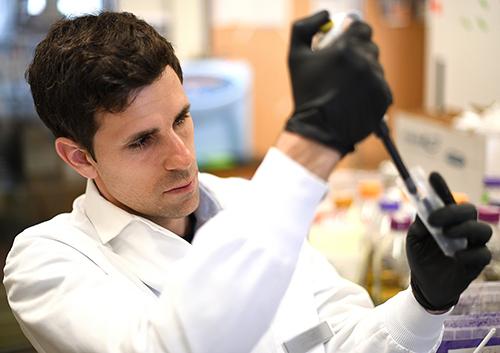
“There is a need for biodegradable diagnostic testing,” said Cesar de la Fuente, PhD (above), Presidential Assistant Professor in the Psychiatry Department at the University of Pennsylvania’s Perelman School of Medicine. “We will be continuing to perfect this technology, which could hopefully help many people in the future, while also looking to expand it to other emerging pathogens in anticipation of future pandemics.” Clinical laboratories engaged in SARS-CoV-2 testing during the COVID-19 pandemic can attest to the massive amounts of waste generated by traditional PCR testing. (Photo copyright: University of Pennsylvania.)
Evolution of Improvement for SARS-CoV-2 Diagnostic Assays
Cesar de la Fuente, PhD, is Presidential Assistant Professor in the Psychiatry Department at the Perelman School of Medicine. His lab has been hard at work since the start of the pandemic to improve COVID-19 testing. The recent study was a collaboration between University of Pennsylvania’s de la Fuente Lab and William Reis de Araujo, Professor in Analytical Chemistry at the State University of Campinas (UNICAMP) in São Paulo, Brazil.
De Araujo leads the Portable Chemical Sensors Lab and has been pairing his electrochemistry expertise with de la Fuente’s lab for years, Penn Engineering Today noted.
The team wanted to combine the speed and cost-effectiveness of previous rapid tests with an eco-friendly biodegradable substrate material.
Bacterial cellulose (BC) was a great choice because it “naturally serves as a factory for the production of cellulose, a paper-like substance which can be used as the basis for biosensors,” Penn Engineering Today reported.
Additionally, BC has an excellent track record for a variety of uses, such as regenerative medicine, wound care, and point-of-care (POC) diagnostics, the blog post noted. UPenn’s test offers speed and accuracy without needing costly equipment making it desirable for clinical laboratories preparing to fight the next pandemic.
The test has shown to be capable of “correctly identifying multiple variants in under 10 minutes. This means that the tests won’t require ‘recalibration’ to accurately test for new variants,” Penn Engineering Today added.
Innovation Born from Inspiration
Though rapid tests are essential to help curb the spread of COVID-19, the negatives that come with these tests didn’t sit well with the UPenn team. This spurred them to strive for improvements.
PCR tests “are hampered by waste [metal, plastic, and the aforementioned PCBs]. They require significant time [results can take up to a day or more] as well as specialized equipment and labor, all of which increase costs,” Penn Engineering Today noted.
Additionally, “Sophistication of PCR tests makes them harder to tweak and therefore slower to respond to new variants,” the blog post concluded.
“There’s a tension between these two worlds of innovation and conservation,” de la Fuente told Penn Engineering Today. “When we create new technology, we have a responsibility to think through the consequences for the planet and to find ways to mitigate the environmental impact.”
Need for Biodegradable Diagnostic Tests
“COVID-19 has led to over 6.8 million deaths worldwide and continues to affect millions of people, primarily in low-income countries and communities with low vaccination coverage,” the Cell Reports Physical Science paper noted.
“There is a need for biodegradable diagnostic testing,” de la Fuentes told Penn Engineering Today. “We will be continuing to perfect this technology, which could hopefully help many people in the future, while also looking to expand it to other emerging pathogens in anticipation of future pandemics.”
While UPenn’s test will require clinical trials and FDA approval before it can become available to clinical laboratories and for point-of-care testing, it promises a bright, eco-friendly future for rapid viral testing.
Citizens claiming racial diversity increased by 276% in the 2020 census, leading experts to wonder if racial diversity is increasing or if people are simply electing to identify as such and how this trend will affect healthcare
Once again, we see another unexpected consequence to expanded DNA testing done by consumers for their own interests and needs. As NPR recently reported in “The Census Has Revealed a More Multiracial US. One Reason? Cheaper DNA Tests,” the growing trend of ordering low-cost direct-to-consumer (DTC) genetic testing to identify cultural heritage (where a family came from) and genealogy (to connect with extant family members) has educated healthcare consumers more about their cultural roots.
Such knowledge, NPR speculates, is allowing people to complete their census survey with more accurate “heritage” classifications.
The last US census showed an interesting change compared to previous census surveys. More Americans identified themselves as racially diverse than in previous censuses. Scientists in multiple specialty areas—including demographics, sociology, genetics, and more—are asking why.
According to federal Census Bureau data, in the most recent census, people who identify as more than one race rose by 276%! Scientists are only just beginning to hypothesize the reasons for this increase, but three potential factors, NPR reported, have emerged:
More children are being born to parents who identify with racial groups that are different from one another.
People are reconsidering what they want the government to know about their identities, according to Duke University Press.
The increased incidence of DNA testing for cultural heritage may be an additional factor in the different ways people identified themselves during the census, driving its popularity, NPR noted. More people are purchasing at-home DNA tests to learn where their ancestors lived and came from, and their family’s genealogy.
“Exactly how big of an effect these tests had on census results is difficult to pin down,” NPR reported. “But many researchers agree that as the cost of at-home kits fell in recent years, they have helped shape an increasing share of the country’s ever-changing ideas about the social construct that is race.”
How the Census Alters Government Policy
Pew Research noted that, although only about 16% of Americans have taken an ancestry DNA test, the marketing efforts of “companies such as 23andMe and Ancestry.com, which operates the AncestryDNA service, should not be underestimated,” NPR reported. They have a wide reach, and those efforts could be impacting how people think about race and ethnic identity.
For most of human history, social experience and contemporary family history have been the drivers of how people identified themselves. However, low-cost DTC genetic testing may be changing that.
“The public has kind of taken in the notion that you can find out ‘who you are’ with a test that’s supposed to analyze your genes,” Jenifer Bratter, PhD (above), a Professor of Sociology at Rice University who studies multiracial identity, told NPR. “What that does for anyone who does work in racial identity and racial demography is cause us to think through how genetic ideas of race are in public circulation.” Desire by healthcare consumers to know their risk for chronic disease has already driven a marked increase in demand for low-cost DNA testing, which has also affected the types of test orders clinical laboratory are receiving from doctors. (Photo copyright: Rice University.)
One concern that sociologists and demographers have about this trend is that the US census is an important tool in policy, civil rights protections, and even how researchers measure things like healthcare access disparities.
“You’re going to have a lot more people who are not part of marginalized groups in terms of their social experiences claiming to be part of marginalized groups. When it comes to understanding discrimination or inequality, we’re going have very inaccurate estimates,” says Wendy Roth, PhD, Associate Professor of Sociology, University of Pennsylvania, told NPR.
They developed the “genetic options” theory, “to account for how genetic ancestry tests influence consumers’ ethnic and racial identities.” They wrote, “The rapid growth of genetic ancestry testing has brought concerns that these tests will transform consumers’ racial and ethnic identities, producing “geneticized” identities determined by genetic knowledge.”
However, a more healthcare-related motivation for taking a DTC DNA test is to learn about one’s potential risks for familial chronic health conditions, such as cancer, heart disease, and diabetes, etc.
“Whether that occurs through your primary care doctor, your large integrated health network, or your payor, I think there will be profound changes in society’s tolerance for using genetics for prevention,” he told GenomeWeb.
Regardless, as Dark Daily reported in 2020, sales of genetic tests from Ancestry and 23andMe show the market is cooling. Thus, with less than 20% of the population having taken DNA tests, and with sales slowing, genetics testing may not affect responses on the next US census, which is scheduled for April 1, 2030.
In the meantime, clinical laboratory managers should recognize how and why more consumers are interested in ordering their own medical laboratory tests and incorporate this trend into their lab’s strategic planning.
The rapid diagnostic test costs less than $5 per unit and can be adapted for other diseases, the developers say, which opens a slew of possibilities for clinical laboratories
Just as the SARS-CoV-2 coronavirus spurred deployment of new vaccine technology based on messenger RNA (mRNA), the COVID-19 pandemic also could prove to be a watershed for in vitro diagnostics (IVD) innovation in ways that benefit clinical laboratories.
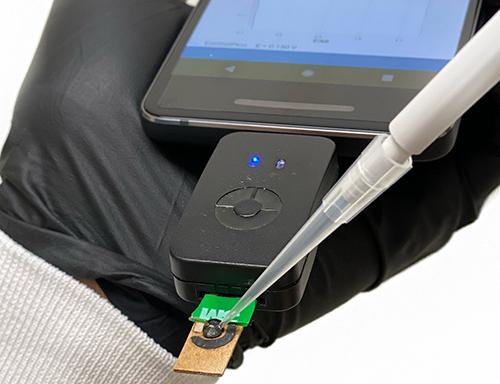
A Penn Medicine news release noted that “The RAPID technology … transforms the binding event between the SARS-CoV-2 viral spike protein and its receptor in the human body, the protein ACE2 (which provides the entry point for the coronavirus to hook into and infect human cells), into an electrical signal that clinicians and technicians can detect. That signal allows the test to discriminate between infected and healthy human samples. The signal can be read through a desktop instrument or a smartphone.”
Though still in its early stages, the technique potentially offers dramatically lower costs and faster results than traditional RT-PCR (reverse transcription polymerase chain reaction) molecular tests. Moreover, the RAPID technology might be useful for identifying other types of biomarkers and could be the basis for diagnostic tests that help reduce the cost-per-test in medical laboratory testing while providing comparable sensitivity and specificity to existing methodologies.
Clinical trials began on January 5, 2021, and the Penn Medicine researchers say the IVD test technology can be applied to other infectious diseases, which, if proven accurate, would be a boon to clinical laboratory testing.
Diagnostic Test Results in Four Minutes for Less than $5/Test
According to the news release, the RAPID 1.0 (Real-time Accurate Portable Impedimetric Detection prototype 1.0) biosensor test costs less than $5 and can deliver results in four minutes. The researchers reported overall accuracy of 87.1% on (139) nasal swab samples and 90% on (50) saliva samples.
The technology uses electrodes that can be mass-produced at low cost on commercially-available screen printers, the researchers said. Results can be read on electronic devices connected to a PC or smartphone.
RAPID 1.0 (above) is a low-cost COVID-19 diagnostic test developed at the César de la Fuente clinical laboratory at the Perelman School of Medicine University of Pennsylvania in Philadelphia. At less than $5/test, plus the ability to be adapted to other diseases, clinical laboratories performing disease screenings in rural or remote locations may have a new tool in the fight against infections. (Photo copyright: University of Pennsylvania.)
Does Penn Medicine’s RAPID 1.0 Test Replace Traditional RT-PCR Testing?
In their published study, the Penn Medicine researchers cited the need for “fast, reliable, inexpensive, and scalable point-of-care diagnostics.”
RT-PCR tests, they said, “are limited by their requirement of a large laboratory space, high reagent costs, multistep sample preparation, and the potential for cross-contamination. Moreover, results usually take hours to days to become available.”
Researchers who have studied the SARS-CoV-2 coronavirus know that it uses a spike-like protein to bind to angiotensin-converting enzyme 2 (ACE2) receptors on the surfaces of human cells.
As described in Penn Medicine’s published study, the biosensor contains ACE2 and other biochemical agents anchored to an electrode. When the SARS-CoV-2 coronavirus attaches to the ACE2, the biosensor transforms the chemical reaction into an electrical signal that can be measured on a device known as a potentiostat.
The researchers tested their RAPID 1.0 technology with two commercially available potentiostat models:
The researchers initially developed the electrode as a printed circuit board, which is relatively expensive. To reduce costs, they constructed a version that uses filter paper as the main component. The researchers noted that one screen printer in a lab can produce 35,000 electrodes per day, including time needed to incorporate the chemical elements. “However, it must be noted that these steps can be fully automated into a production line for industrial purposes, drastically reducing time requirements,” they wrote.
The test can be performed at room temperature, they added, and total cost per unit is $4.67. Much of that—$4.50—is for functionalizing the ACE2 recognition agent. The cost for the bare electrode is just seven cents.
“The overall cost of RAPID may be further reduced through recombinant production of ACE2 and ACE2 variants,” the researchers said, adding that the RAPID 1.0 test can detect the SARS-CoV-2 coronavirus at low concentrations correlating to the earliest stages of the COVID-19 disease.
The Penn Medicine research team was led by César de la Fuente, PhD (above), an Assistant Professor in Psychiatry, Microbiology, Chemical and Biomolecular Engineering and Bioengineering at the Perelman School of Medicine. “Prior to the pandemic, our lab was working on diagnostics for bacterial infections,” he said in the Penn Medicine news release. “But then, COVID-19 hit. We felt a responsibility to use our expertise to help—and the diagnostic space was ripe for improvements.” (Photo copyright: University of Pennsylvania.)
Testing Penn Medicine’s RAPID 1.0 Test
The researchers evaluated the technology in blinded tests with clinical samples from the Hospital of the University of Pennsylvania. The evaluation included 139 nasal swab samples, of which 109 were determined to be COVID-19 positive by RT-PCR tests and clinical assessments. Among these, the RAPID test successfully detected the SARS-CoV-2 coronavirus in 91 samples, for a sensitivity rate of 83.5%. One sample was from a patient diagnosed with the highly contagious SARS-CoV-2 Alpha variant B.1.1.7, which the test correctly identified as positive.
Among the 30 samples determined to be COVID negative, the RAPID test scored a specificity rate of 100%, meaning no false positives. Overall accuracy, including sensitivity and specificity, was 87.1%.
The researchers also analyzed 50 saliva samples: 13 COVID-positive and 37 COVID-negative. The test correctly identified all 13 positive samples but produced five false-positives among the 37 negative samples, for a specificity rate of 86.5%. The researchers speculated that this could be due to interactions between ACE2 and other biomolecules in the saliva but suggested that performance “will improve when using fresh saliva samples at the point-of-care.”
Are There Other Applications for the RAPID Test?
The Penn Medicine news release said the RAPID technology can be adapted to detect other viruses, including those that cause Influenza and sexually-transmitted diseases.
Robert Michel, Editor-in-Chief of Dark Daily and its sister publication The Dark Report, said the test points to one silver lining in the COVID-19 pandemic. “Researchers around the world intensified their work to find ways to identify the SARS-CoV-2 virus that are faster, cheaper, and more accurate than the diagnostic technologies that existed at the time of the outbreak. In this regard, the COVID-19 pandemic may have accelerated the development and refinement of useful diagnostic technologies that will disrupt long-established methods of testing.”
Marcelo Der Torossian Torres, PhD, postdoctoral researcher at Penn Medicine and lead author of the study, said in the news release, “Quick and reliable tests like RAPID allow for high-frequency testing, which can help identify asymptomatic individuals who, once they learn they are infected, will stay home and decrease spread.
“We envision this type of test being able to be used at high-populated locations such as schools, airports, stadiums, companies—or even in one’s own home,” he added.
Clinical laboratory managers may want to stay current on the development and possible commercialization of the RAPID 1.0 (Real-time Accurate Portable Impedimetric Detection prototype 1.0) biosensor test by the research team at Penn Medicine.
Online reputation management is increasingly becoming a critical function that all providers, including clinical laboratories, must address or risk losing revenue
Recent surveys cite growing evidence that Facebook (NASDAQ:FB) and online review sites such as Yelp (NYSE:YELP) are swiftly becoming healthcare consumers’ preferred sources for researching doctors, hospitals, medical laboratories, and other medical service providers.
Healthcare consumers are using the Internet to review information
on healthcare providers prior to visits. More important, data show a majority
of Americans share their healthcare experiences publicly online following
visits with providers.
This should serve as a wakeup call for clinical laboratories and anatomic pathology groups that have not developed effective social media strategies, as they are clearly among the health services being evaluated.
More than half of Americans (51%) reported sharing their healthcare experiences online, an increase of 65% over just one year ago;
Among Millennials (people born between 1981 and 1996) that number jumps to 70%, a 94% increase over last year;
70% of Americans overall say online ratings and reviews influenced their choices of physicians and facilities;
More than 40% of respondents admitted they researched doctors online even after being referred to them by another healthcare professional.
“The survey results underscore the significance of online ratings and reviews as online reputation management for physicians becomes ever-more important in today’s healthcare environment,” said Aaron Clifford, Senior Vice President of Marketing at Binary Fountain, in a statement. “As patients are becoming more vocal about their healthcare experiences, healthcare organizations need to play a more active role in compiling, reviewing, and responding to patient feedback if they want to compete in today’s marketplace.”
Healthcare Dive also noted that Millennials are likely to consider online reviews and ratings of healthcare professionals to be trustworthy.
97% of 24- to 34-year-olds report believing
online comments are reliable;
While 100% of the 18- to 24-year-olds surveyed felt
similarly.
Pathologists and clinical laboratory administrators should
consider the two findings above as evidence that a major change has already
happened in how the younger generations look for—and select—their hospitals,
their physicians, and their clinical laboratory providers. Thus, every
pathology group and clinical laboratory should have a business strategy for
managing the Internet presence of their labs. Failure to do so means that
competing labs that do a good job of managing their Internet presence will be
more successful at winning the lab testing business of Gen Xers (born
1965-1980), Millennials (Gen Y, born 1981-1996), and Gen Z (born 1997-2009).
In addition, the survey discovered that the most important
qualities consumers look for in a doctor are:
Friendly and caring attitudes;
Physicians’ ability to answer questions; and
Thoroughness of examinations.
Those polled reported the most frustrating issues when
dealing with healthcare professionals were:
Office wait times;
Cost and payment concerns;
Wait times for exam and medical laboratory
results; and
Scheduling appointments.
It’s All in a Word
Earlier this year, Healthcare Dive also reported on research that examined online reviews and their content conducted by Penn Medicine. Researchers at the University of Pennsylvania used digital tools and data analytics to help healthcare providers better understand and improve the patient experience.
The researchers analyzed 51,376 online reviews about 1,566
hospitals posted on Yelp over a 12-year period. They published their findings in
the Journal
of General Internal Medicine (JGIM).
They concluded the word most often found in positive Yelp
reviews was “friendly.” Their example of how positive review writers used this word:
“The doctors, nurses, and X-ray technician who helped me out were all so cool
and friendly. It really restored my faith in humanity after I got hit on my
bike.”
Other words the researchers commonly found in good online
reviews include “great, staff, and very.”
“Told” was the word most often found in negative reviews. The
researchers’ example: “I constantly told them that none of that was true and
the nurse there wouldn’t believe me.” It appears from the JGIM study
that Millennials often felt healthcare professionals did not listen to them.
The researchers identified “worst, hours, rude, said, no and
not” as other words often found in negative reviews.
“As providers, we need to take a moment to think about how we talk in hospitals, but also what patients are hearing,” said lead author of the Penn Medicine study Anish Agarwal, MD, Assistant Professor of Emergency Medicine at the University of Pennsylvania. “I may say something, but the way it’s heard and interpreted and then processed within patients when they’re going through a vulnerable time can be different.” (Photo copyright: University of Pennsylvania.)
Half of Millennials Prefer Internet Research and Online
Virtual Healthcare
Another survey conducted by Harmony Healthcare IT, a health data management firm based in South Bend, Ind., found that more millennials are researching the Internet for medical advice in lieu of actual doctor visits.
PC Magazine reported Harmony Healthcare IT’s survey found:
73% of Millennials reported following medical
advice found online instead of going to a doctor; and
93% reported researching medical conditions
online in addition to a doctor visit.
The survey also found that 48% of millennials trust online
resources for medical information and that 48% prefer virtual doctor office
visits over in-person visits.
In addition, 24% of this age group have gone five or more years without a physical and 57% prefer high-deductible health plans (HDHPs).
“With an emphasis on convenience, low cost, and technology, it will be interesting to see how this generation helps shape the future of health and how both patients and providers will adapt to those changes along the way,” Harmony Healthcare IT wrote in a blog post.
The results of these surveys illustrate why clinical laboratories
and anatomic pathology groups must have a social media strategy for managing
their reputations and presence on the Internet, especially where Millennials
are concerned.
That strategy should include easy and informative ways for
patients to learn about medical laboratory services, pricing of lab tests,
quality of work, and methods consumers can use to leave online feedback and
receive responses to their comments.