Survey shows more than 50% of hospitals and health systems plan to increase virtual care services within two years, a development that can change how patients access clinical laboratory testing services
If anything positive came out of the COVID-19 pandemic, it’s the growing acceptance by physicians and health payers of telehealth—including telepathology, teleradiology, and other types of virtual doctor visits—as a way for patients to meet with their physicians in place of in-office healthcare.
In earlier coverage about the rapid adoption of telehealth and virtual doctor visits, Dark Daily has observed that this trend creates a unique challenge for clinical laboratories. If the patient has a virtual consultation with his or her physician, how would a clinical laboratory get access to this patient to do a venipuncture and collect the samples necessary to perform the medical laboratory tests ordered by the physician?
Nevertheless, according to multiple reports, healthcare providers are planning to increase investment in telehealth technologies.
Disparate Technologies Led to Technical Difficulties for Virtual Healthcare Providers
The terms telemedicine and telehealth are often used interchangeably. However, according to the American Academy of Family Physicians (AAFP), there are subtle differences worth noting.
Telehealth is a broad term which refers to “electronic and telecommunications technologies and services used to provide care and services at-a-distance [while] telemedicine is the practice of medicine using technology to deliver care at a distance.
“Telehealth is different from telemedicine in that it refers to a broader scope of remote health care services than telemedicine. Telemedicine refers specifically to remote clinical services, while telehealth can refer to remote non-clinical services,” the AAFP notes.
Kelly Lewis, former Vice President of Revenue Strategy and Enablement at telehealth provider Amwell, told Healthcare IT News (HIT News) that “the COVID-19 pandemic caused telehealth adoption to skyrocket.
However, “Because much of this adoption was driven out of an abundance of necessity, there was little time for organizations to think strategically about their technology investments,” she added.
“With urgency at a high, payers, provider organizations and clinicians all turned to the quickest options available so patients could continue to get care. The result, however, was what we are calling platform ‘sprawl’—the use of a number of disparate solutions that are leading to a confusing and frustrating care delivery system and experience.”
Nevertheless, according to a survey conducted by HIT News and HIMSS Analytics, “More than half (56%) of hospital and health system leaders say they are planning to increase their investment in telemedicine during the next two years.” This, “shows that the huge surge in and mainstreaming of telehealth during the ongoing pandemic has caused the C-suite and other healthcare leaders to embrace the technology that has for so long existed on the periphery of medicine,” HIT News noted.
“The clear message is that telehealth is here to stay and will continue to expand,” Lewis told HIT News, adding, “The majority of payers without virtual care offerings also reported planning to add them in the next 24 months.”
“Clinicians agree that moving toward a fully integrated telehealth platform would be beneficial. More than 80% believe investing in a fully integrated virtual or hybrid care system would have a positive impact on clinical outcomes and patient experiences,” Kelly Lewis (above), former VP at telehealth provider Amwell, told Healthcare IT News. Considering the growing demand for telehealth, pathologists and clinical laboratories will need a strategy for supporting virtual healthcare providers. (Photo copyright: Healthcare IT News.)
The HIT News/HIMSS Analytics survey findings suggest telehealth will transition as providers aim for “smart-growth” instead of “pandemic-fueled expediency,” Becker’s Hospital Review reported.
Survey respondents expressed positive attitudes about telehealth:
56% of healthcare leaders plan to increase investment in virtual care over the next two years.
80% of respondents noted “very” or “extremely” important telehealth factors are integrating with existing workflows, fast video connections, and reducing administrative burden.
77% called telehealth platform integration with the electronic health record (EHR) “very” or “extremely” important.
80% envision positive clinical outcomes and patient experiences from a fully integrated telemedicine platform.
75% of payers said a single digital platform has potential to streamline member experiences.
“With telehealth visits stabilizing at roughly 10 times pre-pandemic levels, digital transformation initiatives are rising across the field. As a result of the pandemic, 60% of healthcare organizations are adding new digital projects, with telemedicine becoming a higher priority for 75% of executives (vs. 42% in 2019) to improve the patient experience,” the AHA reported.
Medical laboratories and anatomic pathology groups are advised to keep pace with the changing healthcare landscape which increasingly puts a premium on remote and virtual visits. This has become even more critical as healthcare providers and investors infuse more capital into telehealth technology.
As physicians expand telemedicine virtual office visits post-pandemic, a clinical laboratory strategy to reach patients and acquire specimens will be required.
Strategists agree that big tech is disrupting healthcare,
so how will clinical laboratories and anatomic pathology groups serve virtual
healthcare customers?
Visionary XPRIZE founder Peter Diamandis, MD, sees big tech as “the doctor of the future.” In an interview with Fast Company promoting his new book, “The Future Is Faster Than You Think,” Diamandis, who is the Executive Chairman of the XPRIZE Foundation, said that the healthcare industry is “phenomenally broken” and that Apple, Amazon, and Google could do “a thousandfold” better job.
Diamandis, who also founded Singularity University, a global learning and innovation community that uses exponential technologies to tackle worldwide challenges, according to its website, said, “We’re going to see Apple and Amazon and Google and all the data-driven companies that are in our homes right now become our healthcare providers.”
If this prediction becomes reality, it will bring significant changes in the traditional ways that consumers and patients have selected providers and access healthcare services. In turn, this will require all clinical laboratories and pathology groups to develop business strategies in response to these developments.
Amazon Arrives in Healthcare Markets
Several widely-publicized business initiatives by Amazon, Google, and Apple substantiate these predictions. According to an Amazon blog, healthcare insurers, providers, and pharmacy benefit managers are already operating HIPAA-eligible Amazon Alexa for:
Alexa also enables HIPAA-compliant blood glucose updates as part of the Livongo for Diabetes program. “Our members now have the ability to hear their last blood glucose check by simply asking Alexa,” said Jennifer Schneider, MD, President of Livongo, a digital health company, in a news release.
And Cigna’s “Answers By Cigna” Alexa “skill” gives members who install the option responses to 150 commonly asked health insurance questions, explained a Cigna news release.
“Google plans to disrupt healthcare and use data and artificial intelligence,” Toby Cosgrove, Executive Advisor to the Google Cloud team and former Cleveland Clinic President, told B2B information platform PYMNTs.com.
PYMNTs speculated that Google, which recently acquired Fitbit, could be aiming at connecting consumers’ Fitbit fitness watch data with their electronic health records (EHRs).
“Ultimately what’s best is human and AI collaboratively,” Peter Diamandis, MD, founder of XPRIZE Foundation and Singularity University told Fast Company. “But I think for reading x-rays, MRIs, CT scans, genome data, and so forth, that once we put human ego aside, machine learning is a much better way to do that.” (Photo copyright: SALT.)
Apple Works with Insurers, Integrating Health Data
The Apple Watch health app also enables people to access medical laboratory test results and vaccination records, and “sync up” information with some hospitals, Business Insider explained.
Virtual Care, a Payer Priority: Survey
Should healthcare providers feel threatened by the tech giants? Not necessarily. However, employers and payers surveyed by the National Business Group on Health (NBGH), an employer advocacy organization, said they want to see more virtual care solutions, a news release stated.
“One of the challenges employers face in managing their healthcare costs is that healthcare is delivered locally, and change is not scalable. It’s a market-by-market effort,” said Brian Marcotte, President and CEO of the NBGH, in the news release. “Employers are turning to market-specific solutions to drive meaningful changes in the healthcare delivery system.
“Virtual care solutions bring healthcare to the consumer
rather than the consumer to healthcare,” Marcotte continue. “They continue to
gain momentum as employers seek different ways to deliver cost effective,
quality healthcare while improving access and the consumer experience.”
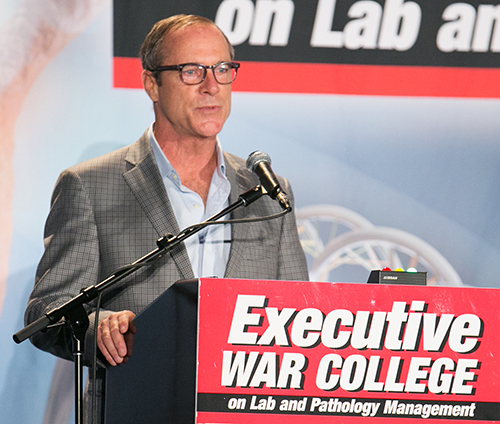
“In AI, there are three trends to watch,” said health strategist Ted Schwab (above) while speaking at the 2019 Executive War College. “The first major AI trend will affect clinical laboratories and pathologists. It involves how diagnosis will be done on the Internet and via telehealth. The second AI trend is care delivery, such as what we’ve seen with Amazon’s Alexa—you should know that Amazon’s business strategy is to disrupt healthcare. And the third AI trend involves biological engineering,” he concluded. (Photo copyright: Dark Daily.)
“If you use Google in the United States to check symptoms,
you’ll get five-million to 11-million hits,” Schwab told The Dark Report.
“Clearly, there’s plenty of talk about symptom checkers, and if you go online
now, you’ll find 350 different electronic applications that will give you
medical advice—meaning you’ll get a diagnosis over the internet. These
applications are winding their way somewhere through the regulatory process.
“The FDA just released a report saying it plans to regulate
internet doctors, not telehealth doctors and not virtual doctors,” he
continued. “Instead, they’re going to regulate machines. This news is
significant because, today, within an hour of receiving emergency care, 45% of
Americans have googled their condition, so the cat is out of the bag as it
pertains to us going online for our medical care.”
Be Proactive, Not Reactive, Health Leaders Say
Healthcare leaders need to work on improving access to primary care, instead of becoming defensive or reactive to tech companies, several healthcare CEOs told Becker’s Hospital Review.
Clinical laboratory leaders are advised to keep an eye on
these virtual healthcare trends and be open to assisting doctors engaged in
telehealth services and online diagnostic activities.