New artificial intelligence model agrees with interpretations of human medical technologists and microbiologists with extraordinary accuracy
Microbiology laboratories will be interested in news from Brescia University in Italy, where researchers reportedly have developed a deep learning model that can visually identify and analyze bacterial species in culture plates with a high level of agreement with interpretations made by medical technologists.
They initially trained and tested the system to digitally identify pathogens associated with urinary tract infections (UTIs). UTIs are the source for a large volume of clinical laboratory microbiological testing.
The system, known as DeepColony, uses hierarchical artificial intelligence technology. The researchers say hierarchical AI is better suited to complex decision-making than other approaches, such as generative AI.
In their Nature paper, the researchers explained that microbiologists use conventional methods to visually examine culture plates that contain bacterial colonies. The scientists hypothesize which species of bacteria are present, after which they test their hypothesis “by regrowing samples from each colony separately and then employing mass spectroscopy techniques,” to confirm their hypotheses.
However, DeepColony—which was designed for use with clinical laboratory automation systems—looks at high-resolution digital scans of cultured plates and attempts to identify the bacterial strains and analyze them in much the same way a microbiologist would. For example, it can identify species based on their appearance and determine which colonies are suitable for analysis, the researchers explained.
“Working on a large stream of clinical data, and a complete set of 32 pathogens, the proposed system is capable of effectively assisting plate interpretation with a surprising degree of accuracy in the widespread and demanding framework of urinary tract infections,” the study authors wrote. “Moreover, thanks to the rich species-related generated information, DeepColony can be used for developing trustworthy clinical decision support services in laboratory automation ecosystems from local to global scale.”
“Compared to the most common solutions based on single convolutional neural networks (CNN), multi-network architectures are attractive in our case because of their ability to fit into contexts where decision-making processes are stratified into a complex structure,” wrote the study’s lead author Alberto Signoroni, PhD (above), Associate Professor of Computer Science, University of Brescia, and his researcher team in their Nature paper. “The system must be designed to generate useful and easily interpretable information and to support expert decisions according to safety-by-design and human-in-the-loop policies, aiming at achieving cost-effectiveness and skill-empowerment respectively.” Microbiologists and clinical laboratory managers will want to follow the further development of this technology. (Photo copyright: University of Brescia.)
How Hierarchical AI Works
Writing in LinkedIn, patent attorney and self-described technology expert David Cain, JD, of Hauptman Ham, LLP, explained that hierarchical AI systems “are structured in layers, each with its own distinct role yet interconnected in a way that forms a cohesive whole. These systems are significant because they mirror the complexity of human decision-making processes, incorporating multiple levels of analysis and action. This multi-tiered approach allows for nuanced problem-solving and decision-making, akin to a seasoned explorer deftly navigating through a multifaceted terrain.”
DeepColony, the researchers wrote, consists of multiple convolutional neural networks (CNNs) that exchange information and cooperate with one another. The system is structured into five levels—labeled 0 through 4—each handling a different part of the analysis:
At level 0, the system determines the number of bacterial colonies and their locations on the plate.
At level 1, the system identifies “good colonies,” meaning those suitable for further identification and analysis.
At level 2, the system assigns each good colony to a bacterial species “based on visual appearance and growth characteristics,” the researchers wrote, referring to the determination as being “pathogen aware, similarity agnostic.”
The CNN used at this stage was trained by using images of 26,213 isolated colonies comprising 32 bacterial species, the researchers wrote in their paper. Most came from clinical laboratories, but some were obtained from the American Type Culture Collection (ATCC), a repository of biological materials and information resources available to researchers.
At level 3, the system attempts to improve accuracy by looking at the larger context of the plate. The goal here is to “determine if observed colonies are similar (pure culture) or different (mixed cultures),” the researchers wrote, describing this step as “similarity aware, pathogen agnostic.” This enables the system to recognize variants of the same strain, the researchers noted, and has the effect of reducing the number of strains identified by the system.
At this level, the system uses two “Siamese CNNs,” which were trained with a dataset of 200,000 image pairs.
Then, at level 4, the system “assesses the clinical significance of the entire plate,” the researchers added. Each plate is labeled as:
“Positive” (significant bacterial growth),
“No significant growth” (negative), or
“Contaminated,” meaning it has three or more “different colony morphologies without a particular pathogen that is prevalent over the others,” the researchers wrote.
If a plate is labeled as “positive,” it can be “further evaluated for possible downstream steps,” using MALDI-TOF mass spectrometry or tests to determine susceptibility to antimicrobial measures, the researchers stated.
“This decision-making process takes into account not only the identification results but also adheres to the specific laboratory guidelines to ensure a proper supportive interpretation in the context of use,” the researchers wrote.
Nearly 100% Agreement with Medical Technologists
To gauge DeepColony’s accuracy, the researchers tested it on a dataset of more than 5,000 urine cultures from a US laboratory. They then compared its analyses with those of human medical technologists who had analyzed the same samples.
Agreement was 99.2% for no-growth cultures, 95.6% for positive cultures, and 77.1% for contaminated or mixed growth cultures, the researchers wrote.
The lower agreement for contaminated cultures was due to “a deliberately precautionary behavior, which is related to ‘safety by design’ criteria,” the researchers noted.
Lead study author Alberto Signoroni, PhD, Associate Professor of Computer Science, University of Brescia, wrote in Nature that many of the plates identified by medical technologists as “contaminated” were labeled as “positive” by DeepColony. “We maximized true negatives while allowing for some false positives, so that DeepColony [can] focus on the most relevant or critical cases,” he said.
Will DeepColony replace medical technologists in clinical laboratories any time soon? Not likely. But the Brescia University study indicates the direction AI in healthcare is headed, with high accuracy and increasing speed. The day may not be far off when pathologists and microbiologists regularly employ AI algorithms to diagnose disease.
New federal funds likely to spark additional growth in hospital-at-home programs across the US while creating need for clinical laboratories to serve these homebound patients
In one of the latest examples of health systems’ providing acute care to patients outside of traditional hospital settings, Orlando Health announced its launch of the Orlando Health Hospital Care at Home program serving central Florida.
According to an Orlando Health press release, “The Orlando Health program is the first in Central Florida to be approved for Medicare and Medicaid patients, with future plans to expand the service for patients with private insurance and at other Orlando Health locations. It is an extension of a federal initiative created during the height of the COVID-19 pandemic to increase hospital capacity and maximize resources.”
Orlando Health is a not-for-profit healthcare system with 3,200 beds at 23 hospitals and emergency departments. It is the fourth largest employer in Central Florida with 4,500 physicians and 23,000 employees. Its Hospital Care at Home program serves patients who meet clinical criteria with 24/7 telehealth remote monitoring and virtual care from the Orlando Health Patient Care Hub. In-person nursing visits are also offered daily, according to Orlando Health.
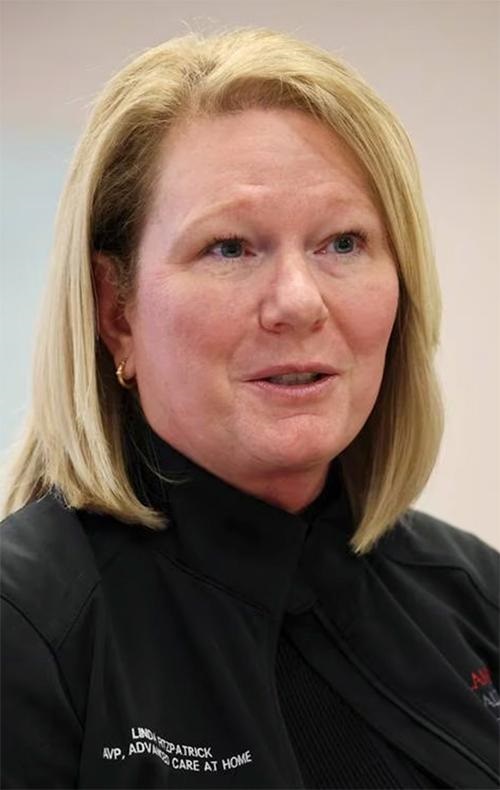
“Orlando Health wanted to be able to provide a different level of care for its patients and give them a different opportunity to be cared for other than the brick-and-mortar of the hospital,” Linda Fitzpatrick (above), Assistant Vice President for Advanced Care at Orlando Health told Health News Florida. “We’ll have decreased infectious rates in their homes, decreased exposures. It is a healthier and happier place to be in order to heal.” Clinical laboratories in the Orlando area will have the opportunity to serve healthcare providers diagnosing patients in non-traditional healthcare settings. (Photo copyright: Orlando Sentinel.)
Lowering Costs and Avoiding In-hospital Infections, Medical Errors
Treating patients at home, even after inpatient visits, can save them money. At the same time, patients are more comfortable in their own homes and that contributes to faster recoveries.
“[We’ll be able to measure] heart rate, respiration, temperature, and blood pressure. We’ll also do video conferencing from that location with the patient. We’ll have nurses going to the patient’s home at least twice a day,” interventional cardiologist Rajesh Arvind Shah, MD, Senior Medical Director of Hospital Care at Home, Orlando Health, told Health News Florida.
Orlando Health patients can be safely treated in their homes for many conditions including:
According to the American Hospital Association (AHA), “many are seeing the hospital-at-home model as a promising approach to improve value. … This care delivery model has been shown to reduce costs, improve outcomes, and enhance the patient experience. In November 2020, the Centers for Medicare and Medicaid Services launched the Acute Hospital Care at Home program to provide hospitals expanded flexibility to care for patients in their homes.”
Hospital-in-the-Home (HITH) is considered by many experts to be safer for patients, as they are not exposed to nosocomial (hospital-acquired) infections, falls, and medical errors. In its landmark “To Err is Human” report of 1999, the Institute of Medicine (IOM) estimated that medical errors killed as many as 98,000 patients in hospitals annually.
And in “Australia’s Hospital-in-the-Home Care Model Demonstrates Major Cost Savings and Comparable Patient Outcomes,” we predicted that wider adoption of that country’s HITH model of patient care would directly affect pathologists and clinical laboratory managers who worked in Australia’s hospital laboratories. Having more HITH patients would increase the need to collect specimens in patient’s homes and transport them to a local clinical laboratory for testing, and, because they are central to the communities they serve, hospital-based medical laboratories would be well-positioned to provide this diagnostic testing.
New Federal Funds for HITH Programs
One recent impetus to create new HITH programs was the passing of the Consolidated Appropriations Act, 2023 (HR 2617). The federal bill includes two-year extensions of the telehealth waivers and Acute Hospital Care at Home (AHCaH) individual waiver that got started during the COVID-19 pandemic.
As of March 20, the federal Centers for Medicare and Medicaid Services (CMS) listed 123 healthcare systems and 277 hospitals in 37 states that had been approved to use the AHCaH wavier.
Now that federal funding for AHCaH waivers has been extended, more healthcare providers will likely start or expand existing HITH programs.
“I think [the renewed funding] is going to allow for additional programs to come online,” Stephen Parodi, MD, Executive Vice President External Affairs, Communications, and Brand, Permanente Federation; and Associate Executive Director, Permanente Medical Group, told Home Health Care News.
“For the next two years, there’s going to be a regulatory framework and approval for being able to move forward. It allows for the collection of more data, more information on quality, safety, and efficiency of these existing programs,” he added. Parodi also oversees Kaiser Permanente’s Care at Home program.
Labs without Walls
Clinical laboratories can play a major role in supporting HITH patients who require timely medical test results to manage health conditions and hospital recovery. Lab leaders may want to reach out to colleagues who are planning or expanding HITH programs now that federal funding has been renewed.
The ongoing study shows promise in the general development of self-powered wearable biosensors, the researchers say, in a development that has implications for clinical laboratory testing
Years back, it would be science fiction to describe a wearable garment that can not only measure an individual’s biomarkers in real-time, but also generates the power the device needs from the very specimen used for the measurement. Clinical laboratory managers and pathologists may find this new technology to be an interesting milestone on the path to wearable diagnostic devices.
With cases of diabetes on the rise across the globe, innovative ways to monitor the disease and simplify care is critical for effective diagnoses and treatment. Now, a team of researchers at Tokyo University of Science (TUS) in Japan have recently developed a diaper that detects blood glucose levels in individuals living with this debilitating illness.
Of equal interest, this glucose-testing diaper has a self-powered sensor that utilizes a biofuel cell to detect the presence of urine, measure its glucose concentration, and then wirelessly transmit that information to medical personnel and patients. The biofuel cell generates its own power directly from the urine.
Glucose in urine provides valuable data regarding blood sugar levels and can be used as an alternative to frequent blood draws to measure those levels. Monitoring the onset and progression of diabetes is crucial to making patient care easier, particularly in elderly and long-term care patients. Widespread use of these diapers in skilled nursing facilities and other healthcare settings could create an opportunity for clinical laboratories to do real-time monitoring of the blood sugar measurements and alert providers when a patient’s glucose levels indicate the need for attention.
“Besides monitoring glucose in the context of diabetes, diaper sensors can be used to remotely check for the presence of urine if you stock up on sugar as fuel in advance,” said Isao Shitanda, PhD, Associate Professor at the Department of Pure and Applied Chemistry, Faculty of Science and Technology, Tokyo University of Science, in a TUS press release. “In hospitals or nursing care sites, where potentially hundreds of diapers have to be checked periodically, the proposed device could take a great weight off the shoulders of caregivers,” he added.
Through electrochemistry, the scientists created their paper-based biofuel cell so that it could determine the amount of glucose in urine via reduction oxidation reactions, or redox for short. Using a process known as “graft polymerization,” they developed a special anode that allowed them to “anchor glucose-reactive enzymes and mediator molecules to a porous carbon layer, which served as the base conductive material,” the press release noted.
The biosensor was tested using artificial urine at different glucose levels. The energy generated from the urine then was used to power up a Bluetooth transmitter to remotely monitor the urine concentration via a smartphone. The TUS researchers determined their biofuel cell was able to detect sugar levels present in urine within one second. The diaper with its sensor could help provide reliable and easy monitoring for diabetic and pre-diabetic patients.
“We believe the concept developed in this study could become a very promising tool towards the general development of self-powered wearable biosensors,” Shitanda said in the press release.
According to the Isao Shitanda, PhD (above), lead author of the TUS study, 34.2 million people, or just over 10% of the US population, were diagnosed with diabetes in 2020. The federal Centers for Disease Control and Prevention estimates that an additional 7.3 million people have diabetes and are undiagnosed. A self-powered biosensor that detects diabetes and prediabetes in urine could help clinical laboratories and doctors catch the disease early and/or monitor its treatment. (Photo copyright: Tokyo University of Science.)
The World Health Organization (WHO) estimates that 422 million people globally were living with diabetes in 2014, and that 1.5 million deaths could be attributed directly to diabetes in 2019.
A panel of colored squares embedded on the front of the diaper changed color if specific chemical reactions fell outside normal parameters. If such a color change was observed, a smart phone application could relay that information to the baby’s doctor to determine if any further testing was needed.
Since we wrote that ebriefing in 2013, Pixie Scientific has expanded its product line to include Pixie Smart Pads, which when added to a diaper, enable’s caregivers to monitor wearers for urinary tract infections (UTI) and report findings by smartphone to their doctors.
These examples demonstrate ways in which scientists are working to combine diagnostics with existing products to help people better manage their health. Wearable electronics and biosensors are increasingly helping medical professionals and patients monitor bodily functions and chronic diseases.
As clever as these new wearable devices may be, there is still the need to monitor the diagnostic data they produce and interpret this data as appropriate to the patient’s state of health. Thus, it is likely that pathologists and clinical laboratory professionals will continue to play an important role in helping consumers and providers interpret diagnostic information collected by wearable, point-of-care testing technology.
Clever entrepreneur thinks up inventive way to truly do clinical laboratory tests at the ultimate point of care and use a smart phone application to alert the doctor
With the advent of digital technology and smartphones, medical laboratory testing is moving out of the central laboratory and into the bedside, homes and now into diapers! A new digital “Smart Diaper” invented by New York startup Pixie Scientific constantly monitor’s a baby’s health to detect urinary tract infections, kidney problems, or dehydration early, before the health issue escalates.
‘Smart Diaper’ Tweets When It Detects a Health Problem(more…)
Pathologists and clinical laboratory managers may want to learn more about the UCheck mobile app developed by Biosense Technologies
Developers of a new iPhone application claim their app can analyze a urine specimen for up to 25 different diseases. This mobile app is a deliberate attempt to give consumers the ability to perform diagnostic tests that would normally be run in a full-scale clinical laboratory.