Organizations representing clinical laboratories and other critical healthcare providers urged Congress to pass the Saving Access to Laboratory Services Act by January 1, 2023, to prevent deep cuts in reimbursements
Lessons about the essential role of clinical laboratories during a pandemic was the central theme in a significant publication released recently. The authors were the presidents of two of the nation’s largest healthcare companies and their goal was to connect the value clinical labs delivered during the COVID-19 pandemic to the financial threat labs face should the Protecting Access to Medicare Act of 2014 (PAMA) fee cuts coming to the Medicare Part B Clinical Laboratory Fee Schedule (CLFS) be implemented.
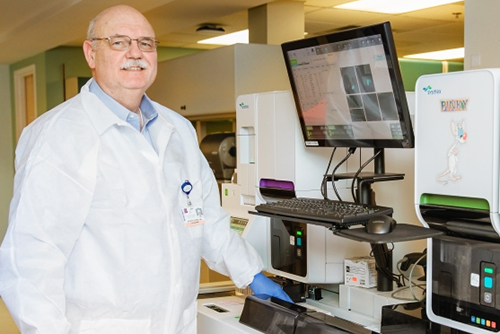
In an article for RealClearPolicy, healthcare executives William G. Morice II, MD, PhD (left), CEO/President, Mayo Clinic Laboratories, and Matt Sause (right), President of Roche Diagnostics North America wrote, “Without PAMA reform, labs could face drastically reduced reimbursement for commonly performed lab tests for a host of diseases.” (Photo copyrights: Mayo Clinic Laboratories/Roche Diagnostics.)
IVD Companies and Clinical Laboratories Sound Alarm
Morice and Sause warn that—without PAMA reform—the nation’s vital medical laboratories will face “drastically reduced reimbursement” for commonly performed lab tests for diseases, including diabetes, heart disease, and cancer. Reimbursement cuts may cause clinical labs serving “the most vulnerable and homebound” to reduce services or close, they noted.
“To emerge from nearly three years of a pandemic by sending the signal that austerity is our nation’s health policy when it comes to testing and diagnostics would be a significant mistake,” they wrote.
“If the proposed cuts to reimbursements for diagnostic tests are allowed to take effect, disparities caused by challenges with accessing diagnostic tests will likely grow even further,” the authors continued.
However, they added, “The Saving Access to Laboratory Services Act [SALSA] would reform PAMA to require accurate and representative data from all laboratory segments that serve Medicare beneficiaries to be collected to support a commonsense Medicare fee schedule that truly represents the market.”
How PAMA Affects Clinical Laboratory Reimbursements
PAMA, which became law in 2014, was aimed at marrying Medicare Part B Clinical Laboratory Fee Schedule (CLFS) reimbursement rates to rates medical laboratories receive from private payers, the National Independent Laboratory Association (NILA) explained in a news release.
But from the start, in its implementation of the PAMA statute, the methods used by the federal Centers for Medicare and Medicaid Services (CMS) to collect data on lab test prices paid by private payers—which were the basis for calculating new lab test prices for the Medicare program—were criticized by many laboratory professionals and other health experts.
Critics frequently pointed out that several types of clinical laboratories were excluded from reporting their private payer lab test prices. Thus, the data collected and used by CMS did not accurately represent the true range of prices paid for clinical lab tests by private health insurance plans, said lab industry groups.
CMS regulations “exclude most hospital outreach laboratories and physician office laboratories from data collection. This approach depresses median prices and has led to deep cuts to lab reimbursement. Many tests were cut up to 30% in 2018 when the new system went into effect,” the America Association for Clinical Chemistry (AACC) noted in a statement.
On September 8, just weeks after publication of the article authored by Morice and Sause, 26 organizations representing clinical laboratories and diagnostics manufacturers sent a letter to Congressional leaders. In it they described the financial impact on labs due to the current law’s omission of some outreach and physician office lab testing, and they urged the passage of the SALSA legislation.
“The significant under-sampling led to nearly $4 billion in cuts to those labs providing the most commonly ordered test services for Medicare beneficiaries,” the organizations wrote in their letter. “For context, the total CLFS spend for 2020 was only $8 billion.”
Reimbursement Cuts to Lab Tests are Coming if SASLA Not Passed
“Without Congressional action, beginning on Jan. 1, 2023, laboratories will face additional cuts of as much as 15% to some of the most commonly ordered laboratory tests,” the NILA said.
“Enactment of the Saving Access to Laboratory Services Act (SALSA/H.R. 8188/S.4449) is urgently needed this year, to allow laboratories to focus on providing timely, high quality clinical laboratory services for patients, continuing to innovate, and building the infrastructure necessary to protect the public health,” NILA added.
In an editorial she wrote for Clinical Lab Products, titled, “Be a Labvocate: Help Pass SALSA Legislation,” Kristina Martin, Clinical Pathology Operations Director, Department of Pathology, University of Michigan Medicine said, “The SALSA legislation provides a permanent, pragmatic approach to evaluating the CLFS, eliminating huge swings, either positive or negative as it pertains to Medicare reimbursement. It also allows for a more comprehensive evaluation of data to be collected from a broader sampling of laboratory sectors.”
Uses statistical sampling for widely available tests performed by a “representative pool of all clinical laboratory market segments.”
Introduces annual “guardrails” aimed at creating limits for reductions as well as increases in CLFS rates.
Excludes Medicaid managed care rates since they are not true “market rates.”
Gives labs the option to exclude mailed remittances from reporting if less than 10% of claims.
Eases clinical labs’ reporting requirements by changing data collection from three years to four.
Make Your Views Known
Proponents urge Congress to act on SALSA before the end of the year. Clinical laboratory leaders and pathologists who want to express their views on SALSA, test reimbursement, and the importance of access to medical laboratory testing can do so through Stop Lab Cuts.org. The website is sponsored by the ACLA.
Survey respondents can give their opinions about the proposed VALID and VITAL acts
Two bills are pending in Congress, and each is written to change the current regulatory scheme for laboratory-developed tests (LDTs) and in vitro clinical tests (IVCTs). The bills go by the acronyms of the VALID Act and VITAL Act. Many clinical laboratories offering LDTs today may be unaware of the details within each bill as currently written.
That existing regulatory arrangement will change if one of the two pending bills in Congress were to pass and be signed into law. That proposal is known as the Verifying Accurate Leading-Edge IVCT Development Act, or VALID Act. It is a bipartisan, 245-page bill that proposes FDA oversight of LDTs and is making its way through both the Senate and the House of Representatives.
A smaller, seven-page counterproposal is also before the Senate called the Verified Innovative Testing in American Laboratories Act, or VITAL Act. The VITAL Act would keep LDTs under CLIA but mandate updates to CLIA’s rules to account for modern tests.
Readers: Are you in favor of more or less regulation of LDTs? Take this quick survey and let us know what you think. Dark Daily wants to know your thoughts about LDT oversight. Click here to take our six-question survey. Results of this survey will be reported in a coming Dark Daily e-briefing.
Alert pathologists and clinical laboratory managers know that behind every bill proposed in Congress is a party with a vested interest that brought the issue to a senator or representative. Once enacted into law, a new bill changes the status quo, generally to the benefit of the private interests that requested that bill. This is true of both the VALID Act and the VITAL Act.
The table at the bottom of this briefing compares the provisions of each act and is current as of March 28.
Who Opposes VALID Act?
The VALID Act is garnering more attention than the VITAL Act.
On March 22, the American Association for Clinical Chemistry (AACC) sent out an email message urging its members to oppose the VALID Act.
“Let your legislators know that that if VALID becomes law, your institution and other hospitals and small commercial laboratories could be forced to stop providing LDTs,” wrote Patricia Jones, PhD, DABCC, FACB, Chair of AACC’s Policy and External Affairs Core Committee. The AACC has long criticized the VALID Act..
On the other side of the debate, Philadelphia-based The Pew Charitable Trusts, a nonprofit that in part analyzes publics policy, has come out in support of the VALID Act’s proposed requirements.
Two bills are pending in Congress about the future of LDT regulation.
“Although the [current] LDT regulatory process offers labs significant flexibility and enables a more rapid response to public health needs when no FDA-cleared or -approved test exists, the relative lack of oversight for LDTs puts the health of patients at risk,” Pew wrote in an October 2021 report on LDTs.
The Advanced Medical Technology Association also supports the VALID Act, as do many manufacturers of in vitro test kits and large commercial labs. Proponents also believe FDA regulation is needed for IVCTs because they are similar to medical devices and bring with them patient safety concerns.
The American Clinical Laboratory Association and the National Independent Laboratory Association (NILA) have not taken formal positions on the VALID Act.
Congress Could Roll VALID Act into MDUFA Vote to Win Passage
There may be an effort to attach the VALID Act to the authorization vote for the Medical Device User Fee Agreement V (MDUFA), according to a February health legislation alert from law firm Akin Gump Strauss Hauer & Feld based in Washington.
MDUFA funding provides resources to the FDA’s medical device review program. Congress is set to receive final MDUFA V recommendations in April.
Nineteen healthcare and lab industry groups, including the American Medical Association, AACC, AMP, and NILA, sent a joint letter to four Congress members on Feb. 23 requesting they deliberate the VALID Act separately and not as part of MDUFA.
Again, please complete this survey and tell us what you think about FDA regulation of LDTs, as defined in the VALID Act, compared to continuing LDT oversight via a modernized CLIA in the VITAL Act.
—Scott Wallask
Comparison of VALID Act and VITAL Act
VALID Act
VITAL Act
Full act name
Verifying Accurate Leading-Edge IVCT Development Act
Verified Innovative Testing in American Laboratories Act
Bill numbers
House Bill H.R.4128 Senate Bill S.2209
Senate Bill S.1666
Sponsors
Sen. Michael Bennet (D-CO) , Sen. Mike Braun (R-IN), Rep. Larry Bucshon, MD (R-IN), Sen. Richard Burr (R-NC), and Rep. Diana DeGette (D-CO)
Sen. Rand Paul (R-KY)
Provisions
Developers shall apply for premarket approval of IVCTs if there is insufficient evidence of analytical validity or clinical validity or if it’s reasonably possible an IVCT will cause serious adverse health effects.
Applications shall include a summary of test data and scientific evidence to support analytical and clinical validity of the test.
Through a technology certification, developers can submit an IVCT to the FDA for review, and if granted, the certification allows them to develop similar tests without going back for review each time.
The FDA must establish a program for rapid review of breakthrough IVCTs that provide effective treatment of life-threatening diseases
The federal government should work to ensure that regulatory oversight of laboratory tests does not limit patient access, impede innovation, or limit a test’s sustainability as a result of being unduly burdensome or beyond the fiscal capacity of the laboratory to reasonably validate and perform.
No aspects of LTDs shall be regulated under the FDA.
No later than 180 days after enactment of the bill, the secretary of health and human services shall report to the Senate’s Committee on Health, Education, Labor, and Pensions about recommendations to update clinical lab regulations and provide an assessment of LDT use during the 2020 pandemic response.
Exemptions
IVCTs being marketed before the VALID Act goes into effect
Low-risk tests
IVCTs that are granted emergency use
No new exemptions
Review timelines
The FDA shall make a decision no later than 90 days after an application is submitted.
No new requirements noted.
Sources: VALID Act and VITAL Act bills. Information is current as of March 28, 2022.
CAP president maintains medical laboratory staff are ‘indispensable’ in pandemic fight and should be in ‘top tier’ for vaccination
As COVID-19 vaccinations continue to roll out, the College of American Pathologists (CAP) is lobbying for clinical pathologists and medical laboratory staff to be moved up the priority list for vaccinations, stating they are “indispensable” in the pandemic fight.
In a news release, CAP’s President Patrick Godbey, MD, FCAP argued for the early vaccination of laboratory workers, “It is essential that early access to the vaccine be provided to all pathologists and laboratory personnel,” he said. “Pathologists have led throughout this pandemic by bringing tests for the coronavirus online in communities across the country and we must ensure that patient access to testing continues. We must also serve as a resource to discuss the facts about the vaccine and answer questions patients, family members, and friends have about why they should get the vaccine when it is available to them.”
In a phone call following a virtual press conference, pathologists and CAP President Patrick Godbey, MD (above), told MedPage Today that even if medical laboratory staff are not directly in contact with patients, they should be considered “top tier” (designated as Phase 1a) for getting the vaccine. “I think they [clinical laboratory workers] should be considered in the same tier as nurses,” said Godbey, who also is Laboratory Director at Southeastern Pathology Associates and Southeast Georgia Health System in Brunswick, Ga. “They’re indispensable. Without them, there’d be no one to run the tests.” (Photo copyright: Southeast Georgia Health System.)
Who Does CDC Think Should Be First to Be Vaccinated?
According toThe New York Times (NYT), there are an estimated 21 million healthcare workers in the United States, making it basically “impossible,” the NYT wrote, for them all to get vaccinated in the first wave of COVID-19 vaccinations.
A December 11, 2020, CDC Morbidity and Mortality Weekly Report, titled, “ACIP Interim Recommendation for Allocating Initial Supplies of COVID-19 Vaccine—United States, 2020,” notes that “The [federal] Advisory Committee on Immunization Practices (ACIP) recommended, as interim guidance, that both 1) healthcare personnel and 2) residents of long-term care facilities be offered COVID-19 vaccine in the initial phase of the vaccination program.”
The ACIP report defines healthcare personnel as “paid and unpaid persons serving in healthcare settings who have the potential for direct or indirect exposure to patients or infectious materials.”
However, a CDC terminology guidance document listed at the bottom of the ACIP report states, “For this update, HCP [Healthcare Personnel] does not include dental healthcare personnel, autopsy personnel, and laboratory personnel, as recommendations to address occupational infection prevention and control (IPC) services for these personnel are posted elsewhere.”
In part, the letter stated, “We are convinced that ACIP did not intend to exclude any healthcare workers from its recommendation to offer vaccinations to healthcare personnel in the initial phase of the COVID-19 vaccination program (Phase 1a). However, we would hate for jurisdictions to overlook dental, autopsy, and laboratory personnel because of a minor footnote in [CDC] guidance that was developed for an entirely different purpose (i.e., infection control).
“We respectfully ask CDC to clarify,” the letter continues, “… that all healthcare workers—including dental, autopsy, and laboratory personnel—are among those who should be given priority access to vaccine during the initial phase of the COVID-19 vaccination program.”
“In the laboratory, they are encountering and handling thousands of samples that have active live virus in them,” said Karger, who called clinical laboratory staff and phlebotomists the “forgotten” frontline healthcare workers. “We’re getting 10,000 samples a day. That’s a lot of handling of infectious specimens, and we do want [staff] to be prioritized for vaccination.”
Karger continued to stress the vital role clinical laboratories play not only in COVID-19 testing but also in the functioning of the overall health system. She added that staff burnout is a concern since laboratory staff have been working “full throttle” since March.
“From an operational standpoint, we do need to keep our lab up and running,” she said. “We don’t want to have staff out such that we would have to decrease our testing capacity, which would have widespread impacts for our health system and state.”
Testing for Post-Vaccine Immunity
The CAP panelists also highlighted the need to prepare for the aftermath of widespread COVID-19 vaccinations—the need to test for post-vaccine immunity.
“It’s not routine practice to check antibody levels after getting a vaccine but given the heightened interest in COVID testing, we are anticipating there is going to be some increased in demand for post-vaccine antibody testing,” Karger said. “We’re at least preparing for that and preparing to educate our providers.”
Karger pointed out that clinical pathologists will play an important role in educating providers about the type of antibody tests necessary to test for COVID-19 immunity, because, she says, only the SARS-CoV-2 spike protein antibody test will check for an immune response.
With the pandemic expected to stretch far into 2021, clinical laboratories will continue to play a crucial role in the nation’s healthcare response to COVID-19. As essential workers in the fight against infectious disease, clinical pathologists, clinical chemists, and all medical laboratory staff should be prioritized as frontline healthcare workers.
PwC’s list of 12 factors that will shape the healthcare landscape in 2018 calls attention to many new innovations Dark Daily has reported on that will impact how medical laboratories perform their tests
PwC’s Health Research Institute (HRI) issued its annual report, detailing the 12 factors expected to impact the healthcare industry the most in 2018. Dark Daily culled items from the list that will most likely impact clinical laboratories and anatomic pathology groups. They include:
How clinical laboratory leaders respond to these items could, in part, be determined by new technologies.
AI Is Everywhere, Including in the Medical Laboratory
Artificial intelligence is becoming highly popular in the healthcare industry. According to an article in Healthcare IT News, business executives who were polled want to “automate tasks such as routine paperwork (82%), scheduling (79%), timesheet entry (78%), and accounting (69%) with AI tools.” However, only about 20% of the executives surveyed have the technology in place to use AI effectively. The majority—about 75%—plan to invest in AI over the next three years—whether they are ready or not.
One such example of how AI could impact clinical laboratories was demonstrated by a recent advancement in microscope imaging. Researchers at the University of Waterloo (UW) developed a new spectral light fusion microscope that captures images in full color and is far less expensive than microscopes currently on the market.
“In medicine, we know that pathology is the gold standard in helping to analyze and diagnose patients, but that standard is difficult to come by in areas that can’t afford it,” Alexander Wong, PhD, one of the UW researchers, told CLP.
“The newly developed microscope has no lens and uses artificial intelligence and mathematical models of light to develop 3D images at a large scale. To get the same effect using current technologies—using a machine that costs several hundred thousand dollars—a technician is required to ‘stitch together’ multiple images from traditional microscopes,” CLP noted.
Healthcare Intermediaries Could Become Involved with Clinical Laboratory Data
Pricing is one of the biggest concerns for patients and government entities. This is a particular concern for the pharmaceutical sector. PwC’s report notes that “stock values for five of the largest intermediaries in the pharmacy supply chain have slumped in the last two years as demands for lower costs and better outcomes have intensified.”
Thus, according to PwC, pressure may come to bear on intermediaries such as Pharmacy Benefit Managers (PBMs) and wholesalers, to “prove value and success in creating efficiencies or risk losing their place in the supply chain.”
Similar pressures to lower costs and improve efficiency are at work in the clinical laboratory industry as well. Dark Daily reported on one such cost-cutting measure that involves shifting healthcare payments toward digital assets using blockchains. The technology digitally links trusted payers and providers with patient data, including medical laboratory test results. (See, “Blockchain Technology Could Impact How Clinical Laboratories and Pathology Groups Exchange Lab Test Data,” September 29, 2017.)
PwC’s latest report predicts 12 forces that will continue to impact healthcare, including clinical laboratories and anatomic pathology groups, in 2018. Click on the image of the cover above to access an online version of the report. (Photo copyright: PwC/Issuu.)
The Opioid Crisis Remains at the Forefront
Healthcare will continue to feel the impact of the opioid crisis, according to the PwC report. Medical laboratories will continue to be involved in the diagnosis and treatment of opioid addition, which has garnered the full attention of the federal government and has become a multi-million-dollar industry.
Security Remains a Concern
Cybersecurity will continue to impact every facet of healthcare in 2018. Healthcare IT News reported, “While 95% of provider executives believe their organization is protected against cybersecurity attacks, only 36% have access management policies and just 34% have a cybersecurity audit process.”
Patients are aware of the risks and are often skeptical of health information technology (HIT), Dark Daily reported in June of last year. Clinical laboratories must work together with providers and healthcare organizations to audit their security measures. Recognizing the importance of the topic, the National Independent Laboratory Association (NILA) has named cybersecurity for laboratory information systems (LIS) a focus area.
Patient Experience a Priority
Although there have been significant improvements in the area of administrative tasks, there is still an enormous demand for a better patient experience, including in clinical laboratories. Healthcare providers want patients to make changes for the better that ultimately improve outcomes and the patient experience is one path toward that goal.
As they follow healthcare reform guidelines to increase quality while lowering costs, state governments will continue to ramp up pressure on healthcare providers and third parties in the area of pricing. Rather than simply requiring organizations to report on pricing, states are moving towards legislating price controls, as Dark Daily reported in February.
Social Factors Affect Healthcare Access
The transition to value-based care makes the fact that patients’ socioeconomic statuses matter when it comes to their health. “The most important part of getting good results is not the knowledge of the doctors, not the treatment, not the drug. It’s the logistics, the social support, the ability to arrange babysitting,” David Berg, MD, co-founder of Redirect Health told PwC.
One such transition that is helping patients gain access to healthcare involves microhospitals and their adoption of telemedicine technologies, which Dark Daily reported on in March.
“Right now, they seem to be popping up in large urban and suburban metro areas,” Priya Bathija, Vice President, Value Initiative American Hospital Association, told NPR. “We really think they have the potential to help in vulnerable communities that have a lack of access.”
“Physician decision-support software utilizes medical laboratory test data as a significant part of a full dataset used to guide caregivers,” Dark Daily noted. “Thus, if the FDA makes it easier for developers to get regulatory clearance for these types of products, that could positively impact medical labs’ ability to service their client physicians.”
Healthcare Delivery During and Following Natural Disasters
PwC predicts the long-term physical results, financial limitations, and supply chain disruptions following natural disasters will continue to affect healthcare in 2018. The devastation can prevent many people from receiving adequate, timely healthcare.
PwC’s report is an important reminder of from where the clinical laboratory/anatomic pathology industry has come, and to where it is headed. Sharp industry leaders will pay attention to the predictions contained therein.
Another big question is whether the lobbying of medical laboratory and pathology societies can educate and convince members of Congress to delay and reform the PAMA Final Rule that uses the market price study of what private payers pay for lab tests
The bad news doesn’t stop there. Lab industry observers say that significant numbers of hospital laboratories and independent lab companies are unprepared for the drop in revenue they will experience once the Medicare price cuts take effect. And, with only 157 days remaining before Jan. 1, 2018, medical laboratory executives and pathologists have precious little time to prepare their labs to operate on significantly less Medicare revenue.
PAMA Market Study of What Private Payers Pay for Clinical Laboratory Tests
Blame it on the Protecting Access to Medicare Act (PAMA) of 2014! PAMA directed CMS to conduct a market study of the lab test prices paid by private health insurers, and then use this data to set the prices of the CLFS. As many lab professionals know, CMS spent the last 24 months publishing a final price reporting rule that defined which medical laboratories must report the prices they are paid by private payers, and then collecting that data.
The data reporting period ended on May 31. In coming months, CMS will publish the new CLFS test prices and allow time for public comment.
First Opportunity to See What Private Payers Pay for Medical Laboratory Tests
The first expert to speak is Lâle White, Executive Chairman and CEO of XIFIN, Inc., a health information technology (HIT) company headquartered in San Diego. Annually, White and her colleagues handle as many as 300 million lab test claims for hundreds of their clinical laboratory clients. Also, XIFIN is electronically interfaced with every health insurance plan in the US. These two facts mean that White has essentially the same data their lab clients reported to CMS.
During her presentation, White will show you how her company analyzed the real information from hundreds of millions of medical lab test claims that were reimbursed by thousands of private payers. You are in for a big surprise!
Learn Why Medicare Lab Test Fee Cuts Will Be Deep and Painful
XIFIN’s conclusions are based on real-world data. They demonstrate how the CMS final rule was written to direct the way federal officials calculate and set the 2018 Part B clinical laboratory test prices, and reveal why the fee cuts will be deep and painful for the lab industry’s highest-volume tests. You’ll hear facts about XIFIN’s analysis and learn to use that knowledge to model and predict precisely how deep Medicare’s revenue cuts to your lab will be when the new price schedule becomes effective on Jan. 1.
Lâle White (above left), CEO of XIFIN, Inc., spoke at the Executive War College on Laboratory and Pathology Management last May, where she shared insights about the coming price cuts to the Medicare Part B Clinical Laboratory Fee Schedule (CLFS). Julie Scott Allen (above right) is Senior Vice President of the District Policy Group, Drinker Biddle, and represents the National Independent Laboratory Association (NILA) in Washington, DC. White and Allen will be speaking at a special Dark Daily webinar later this week on the current status of the Medicare fee cuts and how lab executives should respond to protect the financial integrity of their labs. (White photo copyright: The Dark Report. White photo by Linda Reineke. Allen photo copyright: Drinker Biddle.)
Because it is generally agreed that CMS officials will target the top 20 lab tests by volume for the deepest price cuts, the actual revenue drop will depend on your mix of tests and the volume of Medicare patients associated with each test. CMS says it will use the weighted median of the private payer lab test price data to determine its new Part B fees.
However, that is a flawed approach and the source of much criticism.
White will show why the weighted median generates a lower price than the use of a weighted average calculation. You’ll see the direct impact that CMS’ use of the weighted median will have on your lab’s Medicare revenue, beginning on Jan. 1.
Understanding Current Developments at CMS and Within Congress
Julie Scott Allen will be the second speaker on the July 20 webinar. She is Senior Vice President, District Policy Group, Drinker Biddle, and represents the National Independent Laboratory Association (NILA) in Washington, DC. In this role, Allen works with officials at CMS, the Department of Health and Human Services (HHS), and with members of Congress on issues relevant to the clinical laboratory members of NILA. She regularly participates as part of the Clinical Laboratory Coalition on these matters.
Allen will give you an up-to-the minute perspective on efforts by the clinical laboratory industry to educate officials within Congress, HHS, and CMS about the consequences of allowing the PAMA final rule price cuts to become effective on January 1, 2018. This is important information you can use to craft strategies to protect your lab’s financial stability. You’ll also recognize opportunities to contact your elected officials in Congress at the time when your input can make an important difference.
The message of many in the Clinical Laboratory Coalition to members of Congress is that, if the PAMA Medicare fee cuts happen as planned, many hospital lab outreach programs and community lab companies in the states and districts of the various Senators and Representatives will probably end up going out of business, filing bankruptcy, or selling to a national lab company.
Behind the Scenes on PAMA Fee Cuts, ACA Repeal-and-Replace
Allen will take you behind the scenes of the inside-the-beltway developments that relate to the coming Medicare Part B clinical laboratory fee cuts. Different players from the clinical laboratory community are in discussions with CMS officials about the need to delay and reform the implementation of these price cuts.
Meanwhile, there are several developments unfolding within Congress that affect clinical laboratories. Yes, one of them is the PAMA final rule on lab price cuts. However, congressional efforts to repeal and replace the Affordable Care Act (ACA) are creating opportunities for different medical specialties—including the profession of laboratory medicine—to advocate for needed reforms in their areas of clinical services.
When clinical laboratory and anatomic pathology leaders are informed, they are more effective in two roles:
Protecting the clinical excellence and financial sustainability of their respective laboratories;
Advocating with government officials and lawmakers on the issues that are important to keeping the nation’s laboratories financially viable and key contributors to improving the quality of patient care.