


News, Analysis, Trends, Management Innovations for
Clinical Laboratories and Pathology Groups

Hosted by Robert Michel

News, Analysis, Trends, Management Innovations for
Clinical Laboratories and Pathology Groups

Hosted by Robert Michel

Sign In

Private Equity Firm Acquires Parent Company of Walgreens and Duane Reade

New owner plans to take the pharmacy company private as it continues to shutter retail locations

Last year, Walgreens announced plans to close a large number of its stores “due to financial difficulties and ongoing environmental pressures,” according to Becker’s Hospital Review. Dark Daily has covered the struggles facing all of the major pharmacy companies in many ebriefs over the past few years.

Now, in another sign of the financial woes facing retail pharmacy chains, Walgreens Boots Alliance (WBA) announced in March that it had agreed to be acquired by private equity firm Sycamore Partners. As part of the $10 billion deal, Sycamore will take WBA private, according to a company press release.

The sale is valued at up to $23.7 billion when debt is included. The company’s brands include Walgreens and Duane Reade in the US, and Boots in the UK.

The deal follows WBA’s plans to close approximately 1,200 US retail locations over the next 30 months. The pharmacy company announced the plan last October as it reported an $8.6 billion net loss for the 2024 fiscal year.

“You have a business that is shrinking, and then you layer on losses and cash burn, all of that was the perfect recipe for what we are seeing today,” Jefferies research analyst Brian Tanquilut told Reuters following the March announcement.

WBA said the deal is expected to close in Q4 of calendar year 2025, pending approval by regulators and its shareholders. The agreement includes a “go-shop” provision that allows the company to consider other proposals.

“Given the size and number of moving parts involved—a potential split of the US business, Boots, and Health—we don’t expect a competing bid to come over the top,” Leerink Partners analyst Michael Cherny told Reuters.

“Sycamore will provide us with the expertise and experience of a partner with a strong track record of successful retail turnarounds,” said Walgreens Boots Alliance CEO Tim Wentworth (above) in a press release. “We believe this agreement provides shareholders premium cash value, with the ability to benefit from additional value creation going forward from monetization of the VillageMD businesses.” (Photo copyright: Walgreens Boot Alliance.)

Long Way Down for Walgreens Boots Alliance

The purchase price of this sale demonstrates how far WBA has fallen since its formation in 2014, when Walgreen Co. completed a merger with Alliance Boots GmbH, a large retail group headquartered in Switzerland.

At its peak in April 2015, WBA had a market valuation of more than $100 billion, according to financial reports.

Analysts have pointed to industrywide challenges that have also affected rivals CVS and Rite Aid, according to reports in The New York Times and the Associated Press (AP). These include rising operating costs, declining reimbursement for prescription drugs, and stiff competition from discount retailers such as Amazon and Walmart.

“We are at a point where the current pharmacy model is not sustainable, and the challenges in our operating environment require we approach the market differently,” said WBA CEO Tim Wentworth during a June 2024 call with analysts, the AP reported.

News Outlets Report Questionable Moves Over the Years

Reuters, however, pointed to questionable moves by Stefano Pessina, the former executive chairman of Alliance Boots who became CEO of WBA following completion of the merger in 2014. Pessina is also WBA’s largest shareholder, Reuters noted.

In October 2015, WBA offered $9.5 billion to acquire US pharmacy chain Rite Aid. But the company eventually backed away from the deal as regulators raised antitrust concerns, CNBC reported. Instead, in 2017, WBA paid $4.375 billion to acquire nearly 2,000 of Rite Aid’s 4,600 US retail locations.

“But that store footprint proved too big and soon after the acquisition, Walgreens started to close locations,” Reuters reported.

Billions Spent on Retail Clinic Plans

In July 2020, WBA announced a $1 billion deal with VillageMD to open as many as 700 primary care clinics at Walgreens locations. That deal gave WBA a 30% ownership stake in the provider.

Nine months later, Pessina stepped down as CEO to become executive chairman of the board. Taking his place was former Starbucks chief operating officer Roz Brewer. Under her watch, WBA spent an additional $5.2 billion to take a majority stake in VillageMD, which provides primary care services.

That deal has become a “cash drain,” on WBA, Reuters reported. CNBC noted that other retailers have also faced headwinds in their efforts to provide primary care services. Walmart said it would close its in-store health clinics, and CVS also shuttered dozens of clinics in New England and Southern California.

New CEO and Turnaround Plan

In October 2023, facing declines in profits and its share price, Brewer stepped down as CEO and WBA replaced her with Wentworth, the former CEO of Express Scripts.

In March 2024, Wentworth revealed a turnaround plan that included $1 billion in cost cuts and closure of 160 VillageMD clinics, according to Fierce Healthcare. At the time, the company had already closed hundreds of stores in the US and UK, AP reported.

Wentworth followed that plan with October’s announcement to shutter an additional 1,200 retail locations.

Mizuho Bank analyst Ann Hynes told Reuters that, as a private company, WBA will be better positioned to deal with its challenges because it won’t have to answer to shareholders.

One likely move is a divestment of the company’s stake in VillageMD, Reuters reported. And the Boots portion of WBA’s business is a likely spinoff candidate, analysts told the news outlet.

—Stephen Beale

MEDACorp Survey of Hospital Administrators Shows Inpatient Care is Decreasing; Could Change From Where Clinical Laboratories Receive Orders

As inpatient care declines, outpatient care expands, signaling a shift from where physician orders for medical laboratory tests originate

It’s a well-established fact that the year-over-year increase in the volume of outpatient procedures is consistently greater than 8%, while the annual growth in inpatient admissions is at or below 3%. Clinical laboratory managers and anatomic pathologists are aware of these facts.

MEDACorp, a strategic knowledge resource and subsidiary of Leerink Partners, a Boston-based investment bank that focuses on the healthcare industry, conducted a quarterly survey of hospital administrators from 47 hospitals in June of this year. The purpose was to evaluate healthcare utilization trends for different types of medical facilities.

According to the survey, the “ utilization trends for both [quarter-over-quarter] and [year-over-year] are decelerating across all four sites of service.” However, hospital administrators report the use of inpatient and other hospital services did not fare as well.

“The results are also modestly positive for facilities, with the slowing 0.7% increase in inpatient procedures (IP) utilization still higher than consensus of ~flat (sic) for the coverage group. Significant mix shift continues as IP mix is down and the outpatient procedure (OP) mix is up across all service lines, supporting our recent analyses of an accelerated push to ambulatory sites of service,” the survey noted.

The survey revealed:

  • Inpatient services increased by just 0.7% during the second quarter of 2018, down from 1% growth during the second quarter of 2017;
  • Ambulatory surgery center utilization grew by just 1.4% during the second quarter of 2018, down from 2.2% for the same quarter in 2017; and,
  • Emergency department utilization increased by 0.9% in the second quarter of 2018.

“It was even weaker than many of us expected,” Ana Gupte, PhD, Managing Director, Healthcare Services at Leerink, told Modern Healthcare. “It’s pretty clear there’s no volume rebound.” (Photo copyright: Leerink.)

Inpatient Top Surgeries Predicted to Keep Moving to Outpatient Settings

The Leerink survey found that orthopedic and cardiac procedures are leading the trend of shifting clinical procedures from inpatient to outpatient care. For example, heart surgeries were performed in outpatient settings 9% of the time over the past year and are expected to increase to 12% during the next year. Inpatient heart surgeries are expected to decrease 1% over the next year, moving from 82% to 81% of surgeries performed.

Inpatient hip procedures also are projected to drop from 77% to 75% over the course of the next year, while outpatient hip procedures are expected to increase from 17% to 19%. The survey respondents also expect other surgeries including urological, gynecological, spine and knee procedures to move to outpatient settings over the next year.

Forty-five percent of the respondents in the survey named baby boomers aging into Medicare as the most important driver of hospital utilization. Fifteen percent attributed the trend to the effects of the Affordable Care Act (ACA), and 13% cited the improving US economy as driving the use of outpatient medical facilities.
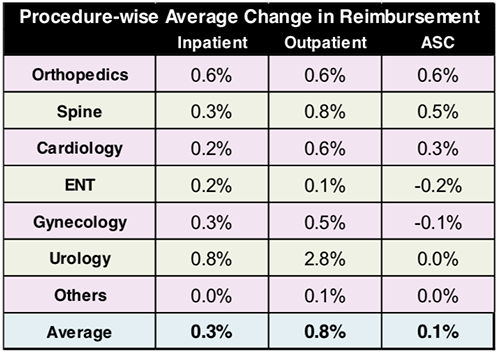
The graphic above, taken from the Leerink MEDACorp survey, illustrates a shift in healthcare procedures from inpatient to outpatient settings. Along with the surgical relocations are changes in reimbursements as well, which directly impacts clinical laboratories revenue streams and billing procedures. (Image copyright: Leerink.)

The survey respondents were from different regions and disparate population areas:

  • 49% of the surveyed facilities were located in metropolitan areas;
  • 40% were in suburban areas; and,
  • 11% were in rural areas.

In addition:

  • 32% were in the South;
  • 26% were in the Northeast;
  • 21% were in the Midwest; and,
  • 21% were in the West.

Most of the facilities used in the survey were community hospitals, which accounted for 62% of the environments. Thirty-two percent of the facilities were academic medical centers, while the remaining 6% were other types of facilities.

The majority of the respondents for the survey were C-suite executives. In hospital settings that would include the Chief Executive Officer (CEO), Chief Financial Officer (CFO), Chief Operating Officer (COO), and other Chief titles, and, of course, hospital administrators.

Clearly, this type of downward trend could negatively impact clinical laboratories, pathology groups, and other service lines in hospital networks. Fewer patients equal less revenue for hospitals, which could eventually lead to budget cuts. A responsible medical laboratory manager will be prepared for these possibilities.

—JP Schlingman

Related Information:

Hospital Execs Say Inpatient Volume Growth Isn’t Rebounding

Hospital Utilization Slows as Healthcare Moves to Cheaper Care Settings

2Q18 Hospital Util. Survey: Utilization Decelerating, Shift To OP/ ASC Continues

ASCs Beat Inpatient Setting for Quarter, Year-over-year Utilization Increases—6 Study Insights

10 Key Trends for ASCs and Outpatient Surgery in the Next 10 Years

;