


Executive War College Keynote Speakers Highlight How Clinical Laboratories Can Capitalize on Multiple Growth Opportunities
From ‘new-school’ rules of running a clinical laboratory to pharmacy partnerships to leveraging lab data for diagnostics, key industry executives discussed the new era of clinical laboratory and pathology operations
Opening keynotes at the 28th Annual Executive War College on Diagnostics, Clinical Laboratory, and Pathology Management taking place in New Orleans this week covered three main forces that healthcare and medical laboratory administrators should be preparing to address: new consumer preferences, new care models, and new payment models.
“COVID-19 didn’t change a whole lot of things in one sense, but it accelerated a lot of trends that were already happening in healthcare,” said Robert L. Michel, Editor-in-Chief of Dark Daily and its sister publication The Dark Report, and Founder of the Executive War College, during his opening keynote address to a packed ballroom of conference attendees. “Healthcare is transforming, and the transformation is far more pervasive than most consumers appreciate.
“Disintermediation, for example, is taking traditional service providers and disrupting them in substantial ways, and if you think about the end of fee-for-service, be looking forward because your labs can be paid for the value you originate that makes a difference in patient care,” Michel added.
Another opportunity for clinical laboratories, according to Michel, is serving Medicare Advantage plans which have soared in enrollment. “Lab leaders should be studying Medicare Advantage for how to integrate Medicare Advantage incentives into their lab strategies,” he said, highlighting the new influence of risk adjustment models which use diagnostic data to predict health condition expenditures.
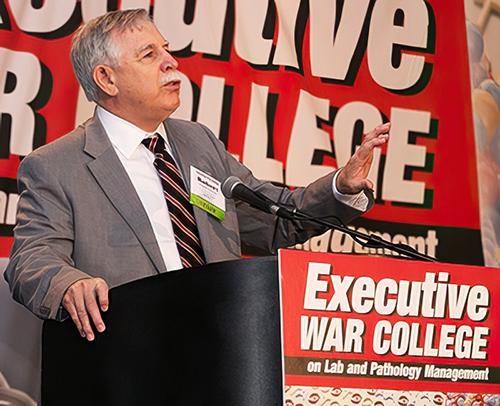
Opening sessions at this week’s annual Executive War College on Diagnostics, Clinical Laboratory, and Pathology Management, presented by Robert L. Michel (above), Editor-in-Chief of Dark Daily and its sister publication The Dark Report, discussed demand for delivering healthcare services—including medical laboratory testing—as consumer preferences evolve, new care models are designed, and as payers seek value over volume. While these three forces may be challenging at the outset, they also create opportunities for clinical laboratories and pathology groups—a focal point of the Executive War College each year. (Photo copyright: The Dark Intelligence Group.)
Medical Laboratories Must Adapt to ‘New-School’ Rules
During his keynote address, Stan Schofield, Vice President and Managing Principal at The Compass Group, noted that while the basic “old-school” rules of successfully running a clinical laboratory have not changed—e.g., adding clients, keeping clients, creating revenue opportunities, getting paid, and reducing expenses—the interpretation of each rule has changed. The Compass Group is a trade federation based in South Carolina that serves not-for-profit healthcare integrated delivery networks (IDNs), including 32 health systems and 600 hospitals.
Schofield advised that when it comes to adding new clients under the “new-school” rules of lab management, clinical laboratory directors must be aware of and adapt to hospital integrations of core labs, clinical integrations across health systems, seamless services, direct contracting with employers in insurance relationships, and direct-to-consumer testing. Keeping clients, Schofield said, involves five elements:
- Strong customer service.
- A tailored metrics program for quality services based on what is important to a lab’s clients.
- Balanced scorecards that look at the business opportunity and value proposition with each client.
- Monitoring patients’ experiences and continuous improvement.
- Participation in all payer agreements.
As to the problem of commoditization of laboratory goods and services, Schofield said, “Right now, we’re facing the monetization of the laboratory. We’re going to swiftly move from commoditization to monetization to commercialization.”
Pharmacies Enter the Clinical Laboratory Market
In another forward looking keynote address, David Pope, PharmD, CDE, Chief Pharmacy Officer at OmniSYS, XiFin Pharmacy Solutions, discussed the “test to treat” trend which could bring clinical laboratories and pharmacies together in new partnerships.
Diagnostics and pharmacy now intersect, according to Pope. “Pharmacists are on the move, and they are true contender as a new provider for you,” he said. “An area of pharmacy that is dependent upon labs is specialty medications.”
Specialty medicines now account for 55% of prescription spending, up from 28% in 2011, driven by growth in auto-immune and oncology, Pope noted. Other examples include companion diagnostics required for targeted treatments pertaining to all major cancers, and new areas like thalassemia (inherited blood disorders), obesity, next-generation sequencing, and pharmacogenomics, in addition to routine testing such as liver function and complete blood count (CBC).
Federal legislation may soon recognize pharmacists as healthcare providers who will be trained to perform specific clinical services, Pope said. Some states already recognize pharmacists as providers, he noted, explaining that pharmacies need lab data for three primary reasons:
- Service—Pharmacies can act as a referral source to clinical laboratories. When referring, pharmacies may need to communicate lab test results to patients or providers to coordinate care.
- Value-based care—Pharmacies would draw on data to counsel, prescribe, and coordinate care for chronic disease management, among other services.
- Diagnostics and pharmacogenetics—Specialty medication workflows require documented test results within a specific timeframe prior to dispensing.
Another point Pope made: Large pharmacies are seeking lab partners. Labs that can provide rapid turnaround time and good pricing on complex tests provide pharmacies with partnership opportunities.
Using AI to Create Patients’ ‘Digital Twins’ That Help Identify Disease and Improve Care
High-tech healthcare technology underlies many opportunities in the clinical laboratory and pathology market, as evidenced throughout the Executive War College’s 2023 curriculum. An ongoing challenge for labs, however, is how to produce the valuable datasets that all labs have the potential to generate.
“It feels like we’ve come so far,” explained Brad Bostic, CEO of hc1 during his keynote address. “We’ve got the internet. We’ve got the cloud. All of this is amazing, but in reality, we have this massive proliferation of data everywhere and it’s very difficult to know how to actually put that into use. And nobody’s generating more data than clinical laboratories.
“Every single interaction with a patient that generates data gives you this opportunity to create the idea of a ‘digital twin.’ That means that labs are creating a mathematical description of what a person’s state is and using that information to look at how providers can optimally diagnose and treat that person. Ultimately, it is bigger than just one person. It’s hundreds of millions of people that are generating all this data, and many of these people fall into similar cohorts.”
This digital twin opportunity is heavily fueled by medical laboratory testing, Bostic said, adding that labs need to be able to leverage artificial intelligence (AI) to:
- Improve lab operations.
- Identify disease earlier.
- Personalize treatment.
- Run predictive analytics.
“I recommend lab leaders sit down with their teams and any outside partners they trust and identify what are their lab’s goals,” Bostic stated. “Think about how this technology can advance a lab’s mission. Look at strategy holistically—everything from internal operations to how patient care is affected.”
Lab and pathology leaders are invited to continue these and other conversations by joining the Executive War College Discussion Group and The Dark Report Discussion Group on LinkedIn.
—Liz Carey
Related Information:
Executive War College on Diagnostics, Clinical Laboratory, and Pathology Management