Representatives from almost 50 different clinical laboratories, professional associations, and societies came together this week to align efforts to expand the supply and retention of qualified laboratory scientists
FORT WORTH, TEXAS—Last week, representatives from a broad cross section of clinical laboratories, lab and pathology associations, public health laboratories, and lab regulatory bodies gathered specifically to identify ways to expand the number of skilled lab professionals.
COLA organized the “Workforce Action Alliance Summit,” a one-day gathering of key clinical laboratory stakeholders who share a common interest in developing initiatives that would directly increase the number of individuals choosing to pursue a career in laboratory medicine.
This is not a new problem, as the lack of trained laboratory scientists across all scientific disciplines has been acute for many years.
In a communication sent to invited participants, COLA’s CEO, Nancy Stratton, and COO, Kathy Nucifora, described the objective of the summit, writing:
“Clearly a call to collective action is required if we are to address the impending clinical laboratory workforce shortage. The past three years have demonstrated the significance of a resilient laboratory infrastructure, not only for the daily care of millions of Americans, but also during the global pandemic. The numerous efforts currently underway to resolve the shortage are unquestionably a component of the solution. Many, however, believe that these efforts are insufficient to close the gap between the projected number of new entrants into the profession, the rate at which those currently in the profession are departing, and the future demand for laboratory testing.”
Robert L. Michel, Editor-in-Chief of Dark Daily’s sister publication The Dark Report was a participant at COLA’S workforce summit. The Dark Report regularly profiles clinical laboratory organizations that have developed innovative and productive initiatives designed to increase the number of students choosing to train as medical technologists (MTs), clinical laboratory scientists (CLSs), medical laboratory technologists (MLTs) and other skilled lab positions.
In materials distributed at the summit, the ongoing gap between demand for skilled lab professionals and the supply was illustrated thusly:
“The US Department of Labor estimates 320,000 bachelors and associates degreed laboratory professionals are working in the United States. If each of those professionals worked a standard 40-year career, the natural annual attrition of 2.5% would require 8,000 new professionals to maintain their current numbers. This exceeds the current output of accredited educational programs by more than 1,000 annually.”
Case Studies of Success
Over the course of the day, participants at the summit heard about the successes of certain laboratory organizations designed to get more students into training programs, supported by the educational courses required for them to become certified in their chosen area of laboratory medicine. These case studies centered around several themes:
Obtaining funding specifically to establish an MT/CLS training program to increase the number of candidates in a region. One example involved ARUP Laboratories and its success at working with a local Congressional representative to get a $3 million federal grant funded as part of a larger legislative package.
The medical laboratory scientist (MLS) program at Saint Louis University (SLU) worked with Quest Diagnostics to launch an accelerated bachelor’s degree program. The 16-month program combines online academic courses with intensive hands-on learning and clinical experiences in Quest’s Lenexa, Kansas, laboratory. The first students in this accelerated degree program began their studies in the spring semester of 2023.
By rethinking the structure of its existing didactic and experiential learning structure, NorthShore University HealthSystem’s MLS program, located at Evanston Hospital north of Chicago, doubled its enrollment capacity.
During the afternoon, working groups addressed ways that lab organizations can collaborate to increase recruitment and retention of laboratory scientists across all disciplines of lab medicine. This input was synthesized into action planning for the three priorities that can lead to expanding the lab workforce.
By day’s end, several working groups were organized with specific next steps. COLA is taking the lead in managing this initiative and giving it momentum. All clinical laboratory professionals and pathologists are welcome to participate in the Workforce Action Alliance (WAA). Anyone wishing to learn more can contact COLA by clicking here, calling 800-981-9883, or by visiting https://education.cola.org/contact-us-page.
Its low cost may advance liquid biopsy cancer testing used by anatomic pathologists and improve outcomes by speeding time to diagnosis and treatment
Researchers in Japan say they have created a circulating tumor cell (CTC) detection solution that is inexpensive and easy to run. Such a device would be of huge interest to investors and companies wishing to develop clinical laboratory tests that use circulating tumor cells in the blood to identify patients with cancer.
In a proof-of-concept study, researchers at Kumamoto University (KU) in Japan have developed and tested a microfilter device they claim can separate and capture CTCs in blood without large equipment, a KU news release reported.
According to Medgadget, the device is an “inexpensive, convenient, and highly sensitive filter that can successfully work in samples containing as few as five tumor cells in one milliliter of blood and does not require expensive equipment or reagents, unlike certain pre-existing cell capture technologies.”
This Technology Could Give Pathologists a Less-Invasive Cancer Test
As medical laboratory scientists and anatomic pathologists know, a CTC test is less invasive than tissue biopsy, which benefits patients. Furthermore, such a CTC test may enable earlier detection of cancer and start of treatment improving odds for success.
Still, there are many pitfalls to overcome when the challenge is to detect cancer cells in a milliliter (about .03 fluid ounce) of blood. As Medgadget put it, “A needle in a haystack doesn’t even come close.”
“Cancer cell count in the blood of cancer patients is extremely low. If these cells are easily detectable, cancer diagnosis may be possible by simply using a blood test, thus reducing patient burden,” the researchers wrote in their paper.
“This work demonstrates that our microfilter device can accurately detect trace amounts of cancer cells in blood,” said study leader Yuta Nakashima, PhD (above), Associate Professor, Department of Mechanical System Engineering at Kumamoto University, in the news release. “We expect it will be adopted for cancer diagnosis and treatment, including for early diagnosis of cancers that cannot be detected by imaging like CT and PET scans, post-operative follow-up, recurrence monitoring, and tailor-made treatments. In the future, we plan to use blood samples donated by cancer patients to verify the practical and clinical application of the method,” he added. Were it to become available, such a CTC test would be a boon for clinical laboratories and anatomic pathologists engaged in cancer diagnostics and treatment. (Photo copyright: Kumamoto University.)
How Does the CTC Filter Device Work?
The KU scientists created a palm-size “cancer detection device using a microfilter and nucleic acid aptamer,” the paper said, adding:
It includes slits to enable a deformation with force of blood pumping through the device.
As blood flows over the microfilter, cancer cells bind to the nucleic acid aptamer.
Force of blood flow opens microfilter slits, pushing away the healthy cells.
Cancer cells are left on the microfilter.
To test the microfilter the researchers used one milliliter of blood that was “spiked with cancer cells,” according to the paper. Findings include:
Detection of five CTCs in one milliliter of blood.
Blood cell removal rate of 98% suggested “no blood cells were absorbed by the microfilter,” the news release said.
The method “showed higher accuracy than the CellSearch System,” the Talanta paper noted.
The KU research team compared their microfluidic device to CellSearch, an FDA-cleared system for detecting CTCs from a blood sample.
CellSearch enables “identification, isolation, and enumeration of CTCs of epithelial origin,” according to Menarini Silicon Biosystems of Castel Maggiore, Italy. It works from a blood sample of 7.5 millimeters with “high level of sensitivity and specificity,” notes the company’s website.
According to Menarini, labs offering CellSearch CTC testing include:
The UK scientists admit that their research needs further study. Nakashima indicated he plans to test blood samples donated by cancer patients in subsequent device trials.
“Although great progress has been made, there is a long way to go before CTC-based liquid biopsy is widely used as a routine test in clinical application,” the authors of that study noted.
Nevertheless, even with more to do, liquid biopsy testing has come a long way, as multiple Dark Daily eBriefs reported over the years.
If the KU scientists succeed in bringing to market a microfilter that can reduce the cost of CTC detection by clinical laboratories while also improving cancer diagnostics, that will have a huge impact on cancer patients and is worthy of clinical laboratory leaders’ attention.
In the absence of a “gold standard,” researchers are finding a high frequency of false negatives among SARS-CoV-2 RT-PCR tests
Serology tests designed to detect antibodies to the SARS-CoV-2 coronavirus that causes the COVID-19 illness have been dogged by well-publicized questions about accuracy. However, researchers also are raising concerns about the accuracy of molecular diagnostics which claim to detect the actual presence of the coronavirus itself.
“Diagnostic tests, typically involving a nasopharyngeal swab, can be inaccurate in two ways,” said Steven Woloshin, MD, MS, in a news release announcing a new report that “examines challenges and implications of false-negative COVID-19 tests.” Woloshin is an internist, a professor at Dartmouth Institute, and co-director of the Geisel School of Medicine at Dartmouth.
“A false-positive result mistakenly labels a person infected, with consequences including unnecessary quarantine and contact tracing,” he stated in the news release. “False-negative results are far more consequential, because infected persons who might be asymptomatic may not be isolated and can infect others.”
Woloshin led a team of Dartmouth researchers who analyzed two studies from Wuhan, China, and a literature review by researchers in Europe and South America that indicated diagnostic tests for COVID-19 are frequently generating false negatives. The team published their results in the June 5 New England Journal of Medicine (NEJM).
For example, one research team in Wuhan collected samples from 213 hospitalized COVID-19 patients and found that an approved RT-PCR test produced false negatives in 11% of sputum samples, 27% of nasal samples, and 40% of throat samples. Their research was published on the medRxiv preprint server and has not been peer-reviewed.
The literature review Woloshin’s team studied was also published on medRxiv, titled, “False-Negative Results of Initial Rt-PCR Assays for COVID-19: A Systematic Review.” It indicated that the rate of false negatives could be as high as 29%. The authors of the review looked at five studies that had enrolled a total of 957 patients. “The collected evidence has several limitations, including risk of bias issues, high heterogeneity, and concerns about its applicability,” they wrote. “Nonetheless, our findings reinforce the need for repeated testing in patients with suspicion of SARS-Cov-2 infection.”
Another literature review, published in the Annals of Internal Medicine, titled, “Variation in False-Negative Rate of Reverse Transcriptase Polymerase Chain Reaction–Based SARS-CoV-2 Tests by Time Since Exposure,” estimated the probability of false negatives in RT-PCR tests at varying intervals from the time of exposure and symptom onset. For example, the authors found that the median false-negative rate was 38% if a test was performed on the day of symptom onset, versus 20% three days after onset. Their analysis was based on seven studies, five of which were peer-reviewed, with a total of 1330 test samples.
Doctors also are seeing anecdotal evidence of false negatives. For example, clinicians at UC San Diego Health medical center treated a patient with obvious symptoms of COVID-19, but two tests performed on throat samples were negative. However, a third test, using a sample from a bronchial wash, identified the virus, reported Medscape.
Sensitivity and Specificity of COVID-19 Clinical Laboratory Tests
The key measures of test accuracy are sensitivity, which refers to the ability to detect the presence of the virus, and specificity, the ability to determine that the targeted pathogen is not present. “So, a sensitive test is less likely to provide a false-negative result and a specific test is less likely to provide a false-positive result,” wrote Kirsten Meek, PhD, medical writer and editor, in an article for ARUP Laboratories.
“Analytic” sensitivity and specificity “represent the accuracy of a test under ideal conditions in which specimens have been collected from patients with either high viral loads or a complete absence of exposure,” she wrote. However, “sensitivity and specificity under real-world conditions, in which patients are more variable and specimen collection may not be ideal, can often be lower than reported numbers.”
In a statement defending its ID Now molecular point-of-care test, which came under scrutiny during a study of COVID-19 molecular tests by NYU Langone Health, Northwell Health, and Cleveland Clinic, according to MedTech Dive, Abbott Laboratories blamed improper sample collection and handling for highly-publicized false negatives produced by its rapid test. An FDA issued alert about the test on May 14 noted that Abbott had agreed to conduct post-market studies to identify the cause of the false negatives and suggest remedial actions.
Issues with Emergency Use Authorizations
In their NEJM analysis, Woloshin et al point to issues with the FDA’s process for issuing Emergency Use Authorizations (EUAs). For example, they noted variations in how manufacturers are conducting clinical evaluations to determine test performance. “The FDA prefers the use of ‘natural clinical specimens’ but has permitted the use of ‘contrived specimens’ produced by adding viral RNA or inactivated virus to leftover clinical material,” they wrote.
When evaluating clinical performance, manufacturers ordinarily conduct an index test of patients and compare the results with reference-standard test, according to the Dartmouth researchers. For people showing symptoms, the reference standard should be a clinical diagnosis performed by an independent adjudication panel. However, they wrote, “it is unclear whether the sensitivity of any FDA-authorized commercial test has been assessed in this way.” Additionally, a reference standard for determining sensitivity in asymptomatic people “is an unsolved problem that needs urgent attention to increase confidence in test results for contact-tracing or screening purposes.”
“To truly determine false negatives, you need a gold standard test, which is essentially as close to perfect as we can get,” Stephen Rawlings, MD, PhD, (above), a resident physician of internal medicine and infectious diseases fellow at UC San Diego’s Center for AIDS Research (CFAR), who has been working on SARS-CoV-2 test validation since March. “But there just isn’t one yet for coronavirus,” he told Medscape. (Photo copyright: University of California, San Diego.)
Continued adherence to current measures, such as physical distancing and surface disinfection.
Development of highly sensitive and specific tests or combinations of tests to minimize the risk of false-negative results and ongoing transmission based on a false sense of security.
Improved RT-PCR tests and serological assays.
Development and communication of clear risk-stratified protocols for management of negative COVID-19 test results.
“These protocols must evolve as diagnostic test, transmission, and outcome statistics become more available,” they wrote.
Meanwhile, clinical laboratories remain somewhat on their own at selecting which COVID-19 molecular and serology tests they want to purchase and run in their labs. Complicating such decisions is the fact that many of the nation’s most reputable in vitro diagnostics manufacturers cannot produce enough of their COVID-19 tests to meet demand.
Consequently, when looking to purchase tests for SARS-CoV-2, smaller medical laboratory organizations find themselves evaluating COVID-19 kits developed by little-known or even brand-new companies.
Limited availability of COVID-19 clinical lab tests is major topic at federal briefings and news stories, yet many of nation’s labs are laying off staff and at point of closing
Cash flow at the nation’s clinical laboratories has crashed, with revenues down by more than $5 billion since early March. This is the biggest financial disaster for the nation’s clinical laboratory industry in its 100-year history and it couldn’t come at a worse time for the American public and the US healthcare system.
At the precise moment when the nation needs clinical laboratories to begin performing millions of tests for SARS-CoV-2, the coronavirus that causes the COVID-19 illness, those same labs are watching their cash flow collapse.
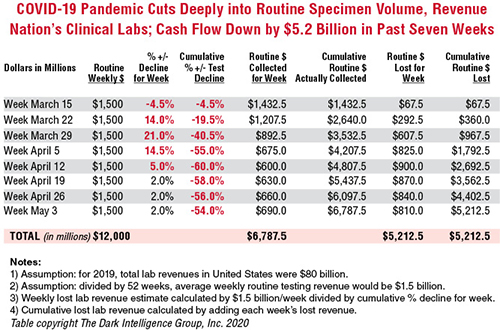
Data from multiple sources gathered by The Dark Report, sister publication of Dark Daily, confirm that—beginning in early March and continuing through last week—clinical laboratories in the United States saw incoming flows of routine specimens decline by between 50% and 60%. During this same time, lab revenue fell by similar amounts.
Clinical Lab Industry Currently Losing $800 to $900 Million Weekly
To give this decline context, the healthcare system spends about $80 billion annually on medical laboratory testing. Thus, labs across the US generated about $1.5 billion in revenue each week during 2019 and into 2020. By April 5, the decline in routine lab specimen volumes reached 55% to 60%. Since then, the clinical lab industry now loses between $800 million and $900 million each week. Total revenue loss from previous levels is already estimated to be $5.2 billion, and it is growing by an additional $800 million to $900 million every week that patients stay away from hospitals and physicians’ offices.
In the eight weeks since the COVID-19 pandemic caused patients to cease coming to hospitals and visiting their doctors, incoming routine specimens and revenue fell by 60%, causing cumulative lost routine revenue of $5.2 billion for the clinical laboratory industry in the United States. Each week that the existing shelter-in-place directives are effective, labs lose another $800 million to $900 million. The Dark Report based these estimates on data provided by multiple companies working with lab billing/claims, middleware analytical solutions, and customer relationship management (CRM) and electronic health record (EHR) products. (Chart copyright: The Dark Intelligence Group, Inc.)
The recent dire financial condition of labs small and large has gone unremarked by federal healthcare officials at the daily White House COVID-19 Task Force briefings. National news sources have yet to report on this development and its implications for successfully expanding the availability and numbers of COVID-19 tests in response to the pandemic.
The rapid and deep decline in specimens and revenue is not limited to clinical laboratories. Biopsy cases referred to anatomic pathology groups have declined by 50% to 60%. Some subspecialty pathology labs saw case referrals drop by 80% or more.
The nation’s two biggest clinical laboratory companies confirmed similar declines in their normal daily flow of routine specimens. Both companies recently reported first-quarter earnings (which included the month of March).
Quest Diagnostics, LabCorp Each Disclose Volume Declines of 50% to 60%
During its Q1 2020 earnings conference call, Chairman, President, and CEO of Quest Diagnostics (NYSE:DGX), Steve Rusckowski, stated, “In April, volume declines continue to intensify as we are seeing signs that volume declines are bottoming out at around 50% to 60%.”
The drop-off in routine lab test referrals was the similar at LabCorp (NYSE:LH). “In our diagnostics business, at the end of the quarter, we experienced reductions in demand for testing of 50% to 55% versus the company’s normal daily levels,” explained Glenn Eisenberg, Executive Vice President and CFO during LabCorp’s Q1 2020 earnings call. “This reduction in demand impacted testing volume broadly but was more heavily weighted towards routine procedures.”
Interviews with independent clinical lab owners and the administrative directors of hospital and health system labs further confirm this rapid and dramatic decline in the number of routine specimens arriving in their labs. Fewer specimens mean fewer claims, which means less revenue to laboratories.
Two Different Financial Futures for ‘Have’ Labs and ‘Have Not’ Labs
What happens next to the clinical laboratory industry in the United States—and to its ability to continue ramping up the availability of adequate numbers of COVID-19 tests in major cities, small towns, and rural areas—will be a story of “haves” and “have nots.”
The “haves” are clinical labs that have access to money. These are publicly-traded lab companies, academic medical center labs, and the sophisticated labs of health networks that operate multiple hospitals. In each case, these organizations have capital reserves and access to loans that will probably enable them to sustain COVID-19 lab testing services at the large volumes required to respond to the pandemic.
clinical labs operated by community hospitals and rural hospitals that were not financially robust before the onset of the pandemic; and,
specialty lab companies that perform a specific number of proprietary diagnostic tests (and for which demand has collapsed as patients stopped seeing their doctors).
Medicare Led Payers in the ‘Lab Test Price Race to the Bottom’
Prior to the onset of the SARS-CoV-2 pandemic, the finances of the “have-not” labs were already shaky, with many on the verge of filing bankruptcy, closing, or selling to a bigger lab company. Much blame for the deteriorating finances at a large proportion of community lab companies, community hospital labs, and rural hospital labs can be attributed to the deep, multi-year price cuts to the Medicare Part B clinical laboratory fee schedule as mandated by the Protecting Access to Medicare Act of 2014 (PAMA).
Medicare’s multi-year cuts to lab test prices were immediately copied by most state Medicaid programs. During this period, private payers followed Medicare’s lead and enacted their own deep cuts to the prices they paid labs for both routine tests and molecular/genetic tests.
That is why—when the pandemic intensified in early March—the 50% to 60% drop in specimens and revenue that hit these labs starved them of essential cash flow. When polled, the owners and directors of these labs acknowledge layoffs of the majority of their staff in all departments. They also reported substantial delays—both in submitted lab test claims and in getting payment for those claims—because claims-processing departments at the labs and private health insurers are understaffed due to shelter-in-place directives.
COVID-19 Test Revenue Helps Only Labs Performing Those Tests
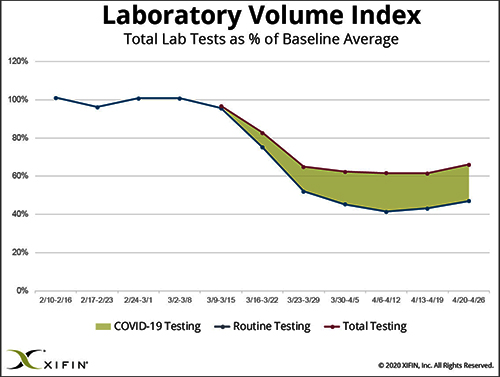
Revenue from COVID-19 testing is helping certain labs offset the revenue loss from fewer routine specimens. XIFIN, Inc., a San Diego company that provides revenue cycle management (RCM) services for clinical laboratories and pathology groups, analyzed the lab test claims for COVID-19 rapid molecular tests. It determined that labs performing these tests are generating enough revenue from these test claims to equal about 20% of their pre-pandemic revenue.
The chart above was prepared by XIFIN, Inc., of San Diego and is based on the changes XIFIN observed in the volume of routine clinical laboratory test claims generated by client labs on a weekly basis. In the first two months of 2020, routine lab test claims ran at expected levels until the first week of March. During the rest of March, routine lab test claims declined by 60%. During April, incoming routine lab test claims remained 55% to 60% below pre-pandemic levels. The shaded area shows the number of COVID-19 test claims coming into clinical labs. XIFIN says COVID-19 test claims make up about 20% of the decline in routine test specimens for those labs performing COVID-19 tests. The Dark Report estimates that the clinical laboratory industry has lost $800 million to $900 million in routine test revenue each week since March 23. Weekly revenue losses will continue at this rate until patients begin visiting their physicians and hospitals again perform elective services. (Chart copyright: XIFIN, Inc.)
Many CLIA-certified community laboratories and hospital labs have the diagnostic instruments and experience to perform rapid molecular tests for COVID-19. But when contacted, they tell us that their suppliers do not ship them even minimal quantities of the COVID-19 kits, the reagents, and the consumables. Thus, they cannot meet the needs of their client physicians. Instead, they watch as these physicians refer COVID-19 tests to the nation’s largest labs. The supply shortage prevents these smaller labs from doing larger numbers of COVID-19 test for the patients in the communities they serve. It also prevents them from earning the revenues from COVID-19 testing that currently helps the nation’s “have” labs offset the decline in revenue from routine testing.
Congress, national healthcare policymakers, and state governors need to immediately address this situation. Each week that passes during the COVID-19 pandemic and the shelter-in-place directives drains another $800 million to $900 million in revenue from routine lab testing that previously flowed into the nation’s clinical laboratories.
‘Have-not’ Clinical Labs in Small Towns Will Quietly Shrink and Disappear
Without timely intervention and financial support, the nation’s network of ‘have not’ labs, which have so capably served towns away from big metropolitan centers and rural areas, will quietly begin shrinking. One at a time, labs in small towns will close or sell. Local lab facilities will be shuttered and specimens from small-town patients will be transported to big labs hundreds or thousands of miles away.
It is also true that the financial disaster besetting the nation’s clinical laboratory industry will have comparable dramatic consequences for the in vitro diagnostics (IVD) manufacturers that sell them automation, analyzers, reagents, and other supplies. Since early March, IVD manufacturers watched as the pandemic caused orders for new instruments to collapse. During these same weeks, their clinical lab customers ceased ordering routine test kits at pre-pandemic levels. Dark Daily will cover the challenges confronting the IVD and other diagnostics industries in future e-briefings.
Announcing Free COVID-19 STAT Intelligence Briefings for Clinical Labs
With the COVID-19 pandemic creating chaos in nearly every aspect of healthcare, business, and society, clinical labs and their suppliers need timely intelligence and analysis about the innovations and successes achieved by their peers. This week, Dark Daily and The Dark Report are launching COVID-19 STAT Intelligence Briefings (Copy and paste this URL into your browser: https://www.covid19briefings.com). This comprehensive service is free and will cover four basic areas of needs for clinical laboratories as they ramp up COVID-19 testing:
Daily and weekly COVID-19 testing dashboards to guide every lab’s short-term planning;
Proven steps for labs to introduce and validate COVID-19 tests (both rapid molecular tests and serology tests);
Getting paid for COVID-19 testing to ensure every lab’s financial stability and clinical quality; and
Legal and regulatory updates for labs doing COVID19 tests to ensure full compliance.
Also, to help clinical laboratory leaders deal with the coming wave of COVID-19 serology tests, we are producing a free webinar led by James O. Westgard, PhD, FACB, and Sten Westgard, Director of Client Services and Technology, of Westgard QC, Inc.
Each week that the SARS-CoV-2 pandemic continues, and strict shelter-in-place directives are in place, the clinical laboratory industry loses another almost $900 million in revenue from lower volumes of routine testing. No industry can survive when its incoming revenue collapses by 50% to 60% for sustained periods of time.
Will Congress Recognize the Need for a Financial Rescue of ‘Have-not’ Labs?
Thus, it is incumbent on Congress, elected officials, and healthcare policymakers to recognize the financial consequences of the pandemic to the nation’s clinical laboratories. That is particularly true of the ‘have-not’ clinical labs. They do not have the same access to decisionmakers in government as billion-dollar lab companies.
And yet, these labs located in small communities and rural areas often are the only local labs that can do STAT testing in a couple of hours, and where clinical pathologists are personally familiar with local physicians and patients.
These “have-not” labs are vital healthcare resources. They should receive the help they need to get through this unprecedented crisis that is the COVID-19 pandemic.
Clinical laboratory leaders interested in positioning their labs to be paid for added-value services will get knowledge, insights, and more at upcoming third annual Clinical Lab 2.0 Workshop in November
It’s a critical time for medical laboratories. Healthcare is transitioning from a fee-for-service payment system to new value-based payment models, creating disruption and instability in the clinical lab test market. In addition, payers are cutting reimbursement for many lab tests.
These are among the market factors leading some pathologists
and clinical lab leaders to seek new or alternative sources of revenue to keep
the lights on and the machines running in their laboratories. Some might say,
it’s a dark time for the lab industry.
“This is not the time to be shy or timid,” he declared. “The
quantitative value of medical laboratory domain is significant and will be lost
if not exploited or leveraged.”
Shotorbani has reason to be positive. In recent years the Project Santa Fe Foundation (PSFF) has emerged to advocate for, and teach, the Clinical Lab 2.0 model. Clinical Lab 2.0 is an approach which focuses on longitudinal clinical laboratory data to augment population health in new payment arrangements.
Earlier this year, PSFF filed for 501(c) status, according to a news release. It is now positioned as a nonprofit organization, guided by a board of directors whose mission is “to create a disruptive value paradigm and alternative payment model that defines placement of diagnostic services in healthcare.”
Progressing Toward Clinical Lab 2.0
At the 24th Annual Executive War College on Lab and Pathology Management held in New Orleans last May, the nation’s first ever Clinical Lab 2.0 “Shark Tank” competition was won by Aspenti Health, a full-service diagnostic laboratory specializing in toxicology screening.
“This project, as well as all of the other cases that were presented, were quite strong and all were aligned with the mission of the Clinical Lab 2.0 movement,” said Shotorbani, in a news release. “This movement transforms the analytic results from a laboratory into actionable intelligence at the patient visit in partnership with front-liners and clinicians—allowing for identification of patient risks—and arming providers with insights to guide therapeutic interventions.
“Further, it reduces the administrative burden on providers by collecting SDH [social determinants of health] predictors in advance and tying them to outcomes of interest,” he continued. “By bringing SDH predictors to the office visit, it enables providers to engage in SDH without relying on their own data collection—a current care gap in many practices. The lab becomes a catalyst helping to manage the population we serve.”
Aspenti Health’s Shark Tank entry, “Integration of the Clinical Laboratory and Social Determinants of Health in the Management of Substance Use,” focused on the social factors tied to the co-use of opioids and benzodiazepines, a combination that puts patients at higher risk of drug-related overdose or death.
The project revealed that the top-two predictors of co-use
were the prescribing provider practice and the patient’s age.
“They did an interesting thing—what clinical laboratories
alone cannot do—the predictive value of lab test data mapped by zip code for
patients admitted in partnership with social determinants of health. This helps
to create delivery models to potentially help prevent opioid overdose,” said
Shotorbani, who sees economic implications for chronic conditions.
“If clinical laboratories have that ability to do that in
acute conditions such as opioid overdose, what is our opportunity to use lab test
data in chronic conditions, such as diabetes? The cost of healthcare is in
chronic conditions, and that is where clinical lab data has an essential role—to
support early detection and early prevention,” he added.
“This is often described as the transition from volume to value because this trend will fundamentally change how all clinical laboratories and anatomic pathology groups are paid,” said Khosrow Shotorbani (above), MBA, MT(ASCP), Executive Director of the Project Santa Fe Foundation (PSFF), during his presentation at the 22nd annual Executive War College in New Orleans. “This shift from volume to value also will create new winners and losers in the clinical lab industry,” he declared. “Not every lab organization will take the timely action required to introduce the value-based laboratory testing services that hospitals, physicians, and payers will need. (Photo copyright: Albuquerque Business First.)
Clinical Laboratory Data is Health Business Data
One clinical laboratory working toward that opportunity is TriCore Reference Laboratories in Albuquerque, N.M. It recently launched Diagnostic Optimization with the goal of improving the health of their communities.
“TriCore turned to this business model,” Shotorbani
explained. “It is actively pursuing the strategy of intervention, prevention,
and cost avoidance. TriCore is in conversation with health plans on how its lab
test data and other data sets can be combined and analyzed to risk-stratify a
population and to identify care gaps and assist in closing gaps.
“Further, TriCore is identifying high-risk patients early
before they are admitted to hospitals and ERs—the whole notion of facilitating
intervention between the healthcare provider and the potential person who may
get sick,” he added. “These are no longer theoretical goals. They are
realizations. Now the challenge is for Project Santa Fe to help other lab
organizations develop similar value-added collaborations in their communities.”
Renee Ennis, TriCore’s Chief Financial Officer, told American Healthcare Leader, “Women go in (to an ER) for some condition, and the lab finds out they are pregnant before anyone else,” she said, adding that TriCore reaches out to insurers who can offer care coordinators for prenatal services.
“There is definitely a movement within the industry in this
direction [of Clinical Lab 2.0],” she added. “But others might not be moving as
quickly as we are. As a leader in this transition, I think a lot of eyes are on
what we are doing and how we are doing it.”
Why Don’t More Lab Leaders Move Their Labs to Clinical
Lab 2.0?
So, what holds labs back from pursing Clinical Lab 2.0?
Shotorbani pointed to a couple of possibilities:
A lab’s traditional focus on volume while not
developing partnerships (such as with pharmacy colleagues) inside the
organization; and
Limited longitudinal data due to a provider’s
sale of lab outreach services or outsourcing the lab.
“The whole notion of Clinical Lab 2.0 is basically connecting the longitudinal data—the Holy Grail of lab medicine. That is the business model. Without the longitudinal view, the ability to become a Clinical Lab 2.0 is extremely limited,” added Shotorbani.
New Clinical Lab 2.0 Workshop Focuses on Critical ‘Pillars’
Project Santa Fe Foundation will host the Third Annual Clinical Lab. 2.0 Workshop in Chicago on November 3-5. New this year are sessions aligned with Clinical Lab 2.0 “pillars” of leadership, standards, and evidence. The conference will feature panels addressing:
C-suite Drivers: moderated by Mark Dixon, President of The Mark Dixon Group;