Theranos founder and former CEO continues down the path she began by defrauding her investors and lying to clinical laboratory leaders about her technology’s capabilities
As a result of the ban, Holmes is “barred from receiving payments from federal health programs for services or products, which significantly restricts her ability to work in the healthcare sector,” ARS Technica reported.
So, Holmes, who is 39-years old, is basically banned for life. This is in addition to her 11-year prison sentence which was paired with $452,047,200 in restitution.
“The exclusion was announced by Inspector General Christi Grimm of the Department of Health and Human Services’ Office of Inspector General,” ARS Technica noted, adding that HHS-OIG also “excluded former Theranos President Ramesh “Sunny” Balwani from federal health programs for 90 years.” This is on top of the almost 13-year-long prison sentence he is serving for fraud.
“The Health and Human Services Department can exclude anyone convicted of certain felonies from Medicare, Medicaid, and Pentagon health programs,” STAT reported.
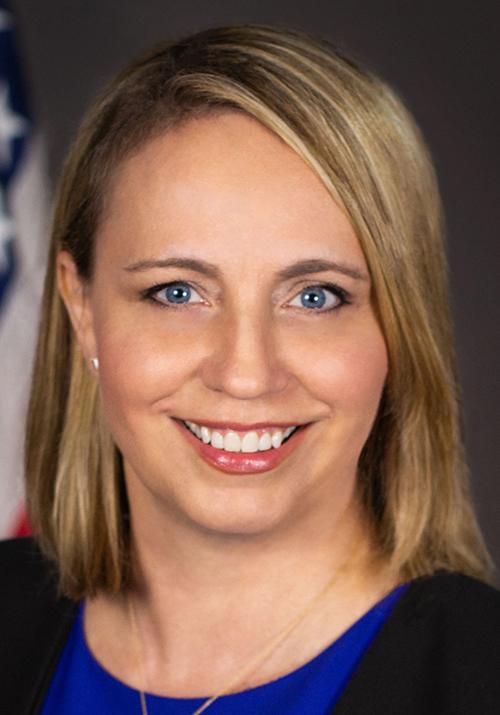
“Accurate and dependable diagnostic testing technology is imperative to our public health infrastructure,” said Inspector General Christi Grimm (above) in an HHS-OIG statement. “As technology evolves, so do our efforts to safeguard the health and safety of patients, and HHS-OIG will continue to use its exclusion authority to protect the public from bad actors.” Observant clinical laboratory leaders will recognize this as yet another episode in the Elizabeth Holmes/Theranos fraud saga they’ve been following for years. (Photo copyright: HHS-OIG.)
Why the Ban?
“The Office of Inspector General (OIG) for the Department of Health and Human Services (HHS) cited Holmes’ 2022 conviction for fraud and conspiracy to commit wire fraud as the reason for her ban,” The Hill reported.
“False statements related to the reliability of these medical products can endanger the health of patients and sow distrust in our healthcare system,” Grimm stated in the HHS-OIG statement, which noted, “The statutory minimum for an exclusion based on convictions like Holmes’ is five years.
“When certain aggravating factors are present, a longer period of exclusion is justified,” the statement continued. “The length of Holmes’ exclusion is based on the application of several aggravating factors, including the length of time the acts were committed, incarceration, and the amount of restitution ordered to be paid.”
Rise and Fall of Elizabeth Holmes
Readers of Dark Daily’s e-briefs covering the Holmes/Theranos fraud saga will recall details on Holmes’ journey from mega success to her current state of incarceration for defrauding her investors.
In November 2022, she was handed an 11-year prison sentence for not disclosing that Theranos’ innovative blood testing technology, Edison, was producing flawed and false results. Theranos had “raised hundreds of millions of dollars, named prominent former US officials to its board, and explored a partnership with the US military to use its tests on the battlefield,” STAT reported.
To get Holmes physically into prison was a journey unto itself. At one point, evidence showed her as a potential flight risk. “In the same court filings, prosecutors said Holmes and her partner, William Evans, bought one-way tickets to Mexico in December 2021, a fact confirmed by her lawyers,” Dark Daily’s sister publication The Dark Report revealed in “Elizabeth Holmes’ Appeal Questions Competence of CLIA Lab Director.”
Drama around her move into prison continued. “The former CEO’s attorneys are making last-minute legal moves to delay her prison sentence while she appeals her guilty verdict,” Dark Daily reported.
At the same time, Holmes appeared to be on a mission to revamp her public image.
In the Times piece, Holmes talked about her plans to continue to pursue a life in healthcare. “In the story, Holmes contended that she still thinks about contributing to the clinical laboratory field. Holmes told The Times that she still works on healthcare-related inventions and will continue to do so if she reports to prison,” The Dark Report covered in “Elizabeth Holmes Still Wants ‘To Contribute’ in Healthcare.”
In the meantime, her legal fees continued to mount beyond her ability to pay. “Holmes’ prior cadre of lawyers quit after she could not compensate them, The Times reported,” The Dark Report noted. “One pre-sentencing report by the government put her legal fees at more than $30 million,” according to The New York Times.
Apparently, this closes the latest chapter in the never-ending saga of Elizabeth Holmes’ fall from grace and ultimate conviction for defrauding her investors and lying to healthcare executives, pathologists, and clinical laboratory leaders.
Zoomers’ unique approach to work and personal health could affect clinical laboratory workplaces, how staff is managed, and how they personally use lab tests
Would it surprise you to learn that Generation Z is poised to make up 75% of the workforce in the United States by 2025? This fact has many implications for clinical laboratories, genetic testing companies, and pathology practices. That’s because Zoomers, as they are called, will be dominant in two ways. First, they will make up the majority of the lab workforce. Second, they will be the majority of consumers and patients accessing medical laboratory testing services.
Zoomers (born 1997-2012) approach work and their own healthcare differently than previous generations. This is partly due to Zoomers being “digital natives who have little or no memory of the world as it existed before smartphones,” according to Pew Research.
Now, a recently released report by economic research firm Glassdoor on 2024 workplace trends states that Zoomers are about to overtake Baby Boomers (born 1946-1964) in the full-time workforce, and that the shift will “represent a pivotal moment of cultural change that US companies cannot ignore.” This includes clinical laboratories and pathology groups that employ them.
According to Glassdoor, Gen Z workers “care deeply about community connections, about having their voices heard in the workplace, about transparent and responsive leadership, and about diversity and inclusion.”
Zoomers bring unique requirements and attitudes to the workplace, but they may also be the fresh infusion of talent a shrinking healthcare workforce needs. It’s no secret that clinical laboratories and pathology groups are facing a labor shortage. An aging workforce combined with burnout from the COVID-19 pandemic have left the entire healthcare industry scrambling for workers.
“A recent survey by Elsevier Health predicts that up to 75% of healthcare workers will leave the profession by 2025. And a 2020 study conducted by the Association of American Medical Colleges (AAMC) projected a shortfall of up to 139,000 physicians by 2033,” Medscape reported.
In “Clinical Laboratories Suffer During the Great Resignation,” Dark Daily noted other causes that are behind the abundance of open positions, such as early retirements, graduating individuals experiencing more specialized training programs, and a shift in the way the current working generation views employment.
Thus, the current healthcare workplace should not only expect unique challenges as Zoomers take over, but also changes that come with adapting to a smaller, younger workforce.
“[Gen Z] will pressure employers to establish a company’s purpose in a way that contributes to a better society and prioritize a company’s purpose along with profits,” Mark Beal (above), Assistant Professor of Professional Practice and Communication at Rutgers University, told Forbes. “Having succeeded at remote learning, they will influence an increased transition to hybrid and remote work as well as the four-day work week.” Clinical laboratories that understand Zoomers’ motivations will likely have more success integrating them into their workforce. (Photo copyright: Rutgers University.)
However, there could be unique challenges with a Zoomer workforce as well. According to Forbes, more than half of these new workers are willing to leave their jobs over “dissatisfaction with fulfillment (59%), professional development (57%), and providing value (53%).”
Although this may make some older workers scoff, each generation has entered the workforce with its own unique perspective based on personal values, and the workplace has shifted and changed to reflect the new workers. The same can be said of the clinical laboratory and pathology workforces.
The chart above shows the different generations as a proportion of the total population of the United States as of 2025. It dramatically illustrates why the largest number of working age individuals will be from Generation Z (aka, Zoomers). With their unique interests and traits, Zoomers will want their workplaces to be responsive in ways that are much different than the generations that preceded them. This will be equally true of how Gen Z accesses clinical laboratory testing services. (Graphic copyright: The Wall Street Journal.)
Gen Z Likes Automation
Another aspect to the increasing Zoomer workforce is Gen Z’s comfort with automated technology. Automation has always shifted how clinical laboratories work, and it can have great benefits for clinical pathology as well.
According to Today’s Clinical Lab, automation reduces error rates by more than 70% and reduces the time needed for each staff member per specimen by 10%.
However, the benefit does not come from automation replacing workers, rather that automated processes reduce repetitive work that takes time and attention away from workers. And, as noted, Gen Z workers tend to be extremely tech-savvy given the prevalence of technology in their lives.
Automation could fill gaps when it comes to labor shortages, not by replacing workers, but by helping adjust the workflow and avoiding worker burnout by automating tedious tasks. And Gen Z workers may be uniquely suited to engage with automated testing technologies.
Evolving Healthcare Workplaces
“The coming year will … represent a pivotal moment of cultural change that US companies cannot ignore as Gen Z workers—who care deeply about community connections, about having their voices heard in the workplace, about transparent and responsive leadership, and about diversity and inclusion—make up a rapidly growing share of the workforce,” the Glassdoor report stated, adding that 2024 “will test the robustness of workplace institutions,” The Hill reported.
Clinical laboratory managers and pathologists will be managing a multi-generational workforce, each with its own attributes and requirements. Thus, lab managers will need to reflect these difference in the management decisions they make and how they organize the laboratory workplace.