


Holmes says life in prison is ‘Hell’ and that Theranos was a failure but ‘not fraud’
For some reason disgraced Theranos founder and ex-CEO Elizabeth Holmes, in a lengthy interview with People magazine, described life in prison while raising her two children even as a three-judge panel of the US 9th Circuit Court of Appeals affirmed her conviction and 11.25-year sentence for fraud.
In June of 2024, Holmes’ defense team appealed to have her conviction overturned due to alleged errors in her trial. According to court documents containing the federal judges’ decisions, her attorneys argued that:
Former Theranos employees who testified as lay witnesses should not have been allowed to offer improper expert testimony.
The court abused its discretion by allowing testimony that Theranos voided all patient sample tests run on a device used in Theranos’s clinical laboratory.
Her rights were violated under the Confrontation Clause of the Sixth Amendment when she was prohibited from cross-examining a former Theranos laboratory director on aspects of his post-Theranos employment.
In February 2025, the judges rejected all points and denied her appeal. Holmes is serving her sentence in a minimum security federal prison camp in Texas and is currently scheduled to be released in 2032.
Elizabeth Holmes (above) taken backstage at TechCrunch Disrupt San Francisco 2014 when Holmes was at the height of her fame and popularity. At this point, Theranos’ Edison blood testing device had not yet been shown to be a fake. But as clinical laboratory scientists and anatomic pathologists studied the technology it was shown to be incapable of producing the results claimed by Holmes and her company president Ramesh Balwani. Today, both are serving lengthy prison sentences for defrauding investors. (Photo copyright: Max Morse/Wikimedia Commons.)
‘Nothing More than a Mirage’
Holmes was convicted in 2022 and sentenced to 135 months for her role in the Theranos fraud case. She was also ordered to pay approximately $452 million in restitution due to her offense, which resulted in significant financial losses to various entities and individuals.
Holmes’ one-time romantic partner and former president of Theranos Ramesh “Sunny” Balwani also was convicted of several fraud charges and sentenced to 155 months in prison.
Theranos claimed to have invented a device called Edison that could run a variety of fast, accurate, and affordable clinical laboratory diagnostic tests from a single finger prick of blood. That’s in contrast to traditional testing methods that require veinous blood drawn with a hypodermic needle. The reality, however, was that the Edison device did not work as described to investors.
“The vision sold by Holmes and Balwani was nothing more than mirage,” wrote 9th Circuit Judge Jacqueline Nguyen, JD, in the panel’s decision, adding that the “grandiose achievements touted by Holmes and Balwani were half-truths and outright lies.”
The judges continued: “Theranos’s blood-testing device failed to deliver faster and more accurate testing results than conventional technology. Pharmaceutical companies never validated the technology, as Holmes and Balwani had told investors. Contrary to the rosy revenue projections shared with investors and business partners, Theranos was running out of money.”
Life Behind Bars
Holmes told People she has adjusted to prison life, waking up every morning just after 5 AM. Her routine includes daily exercise and working as a reentry clerk. Holmes, who was once touted as having an estimated worth of $4.5 billion, now earns just 31 cents an hour teaching fellow inmates how to prepare resumes and apply for jobs and government benefits.
“So many of these women don’t have anyone, and once they’re in there, they’re forgotten,” she told People.
Holmes also teaches French and participates in cognitive and behavioral therapy for post-traumatic stress disorder (PTSD) to address past traumas, including the downfall of Theranos, which was once valued at $9 billion.
“It’s surreal,” she said. “People who have never met me believe so strongly about me. They don’t understand who I am. It forces you to spend a lot of time questioning belief and hoping the truth will prevail. I am walking by faith and, ultimately, the truth. But it’s been hell and torture to be here.”
Raising Children from Prison
Holmes’ trial was delayed three times due to the COVID-19 pandemic and then a fourth time due to a pregnancy. She gave birth to son William a few weeks before her trial began. She later gave birth to daughter Invicta. Both children are being raised by their father Billy Evans, Holmes’ current partner.
Critics allege Holmes only had children to gain sympathy and attempt to avoid prison time. In the People interview, she tried to dispel those claims.
“I know how the optics look, but I always wanted to be a mother,” she said. “I wanted to have children, be a mom. I truly did not think I would ever be convicted or found guilty. I kept talking to my lawyers and they also assured me we would never get this far.
“It wasn’t planned, and I can’t worry about what others think,” she added. “It’s just when the timing happened.”
Holmes’ children will be nine and 10 years-old when she’s slated for release in 2032. She continues to maintain her innocence and considers her trial and conviction a miscarriage of justice. She asserts that while Theranos was a flop, “failure is not fraud.”
“First it was about accepting it happened. Then it was about forgiving myself for my own part. [And] I refused to plead guilty to crimes I did not commit,” Holmes said.
Interestingly, Holmes intends to return to the healthcare industry upon her release. “There is not a day I have not continued to work on my research and inventions,” she told People. “I remain completely committed to my dream of making affordable healthcare solutions available to everyone.”
How she plans to do that given the federal government has banned her for life from operating a clinical laboratory and participating in federal health programs is anyone’s guess.
And thus the life and times saga of Elizabeth Holmes continues.
Former CEO Elizabeth Holmes now awaits March 9 court date on federal fraud charges that include reporting false medical laboratory test results on some patients
Clinical laboratory leaders have watched with keen interest the federal criminal proceedings against disgraced Theranos founder and former CEO Elizabeth Holmes, whose blood-testing company lost nearly $1 billion of investors’ money before dissolving in 2018.
In a recent CNBC interview, John Carreyrou, the Wall Street Journal (WSJ) investigative journalist who first broke the Theranos story in 2015, contended that the once-high-flying Silicon Valley startup could have paid back investors on a pro-rata basis, but that the company opted to use its dwindling cash to challenge lawsuits.
“If you rewind to October 2015, when I finished, when I published my first investigative story on Theranos, the company still had $400 million in the bank and it could have called it quits then,” Carreyrou said in the interview. “And Elizabeth Holmes could have apologized to investors, to patients, to everyone she had misled and returned that money to shareholders on a pro-rata basis.”
Theranos Scandal Breaks Wide Open
Carreyrou’s nearly year-long Wall Street Journal investigation into Theranos helped bring down the venture capital darling that had achieved a $9 billion private valuation before crumbling under the weight of fraud allegations. Dark Daily and our sister publication The Dark Report (TDR) covered in detail the allegations against and investigation into the embattled blood test company in dozens of e-briefings and TDR articles starting in 2015.
In fact, The Dark Report was first to publish the news that Theranos had ceased using its finger-stick collection method in Phoenix as early as April 2015. (See TDR, “Theranos: Many Questions, But Very Few Answers,” April 20, 2015.) At that time, Theranos declined to respond to The Dark Report’s requests for comments.
Theranos had built its superstar reputation on the backs of a revolutionary finger-prick blood testing system, which Holmes promised could diagnosis diseases ranging from diabetes to cancer with just a few drops of blood. But an in-depth investigation into hoopla surrounding the company’s breakthrough technology by Carreyrou and other reporters at the Wall Street Journal revealed it was based on false test results and phony claims to investors and companies, such as Walgreens, which had planned to feature the technology in their retail clinics.
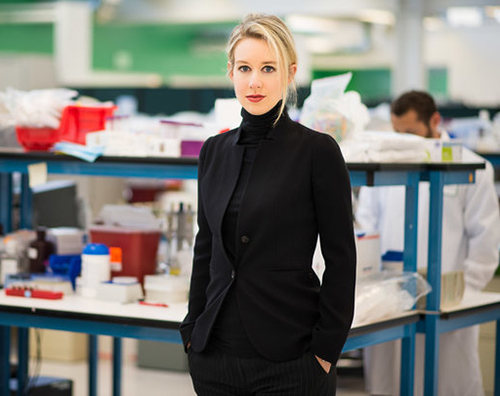
Elizabeth Holmes (above), founder and former CEO of now defunct Theranos, was considered a wunderkind when, as a 19-year-old Stanford University dropout, she founded Theranos in 2003. Early on, she attracted high-profile members to the Theranos board, including former US Secretary of State George Schultz, and cultivated comparisons to legendary Apple CEO Steve Jobs. But once the accuracy of Theranos’ capillary blood-test device fell under suspicion, Holmes’ fall from grace was swift, as clinical laboratories learned from multiple Dark Daily e-briefings and articles in The Dark Report going back to 2015. (Photo copyright: The New York Times.)
In 2016, Theranos received sanctions from the Centers for Medicare and Medicaid Services (CMS), which included revocation of the company’s CLIA certificate and sanctions against Holmes and other company officials that prohibited them from owning or operating a medical laboratory for two years. Soon afterward, Theranos laid off 340 workers, closed its laboratory operations, and shuttered its wellness centers to “focus on an initiative to create miniature medical testing machines,” the New York Times reported.
When Theranos was finally dissolved in September 2018, Carreyrou reported that the company had an estimated $5 million in cash to distribute to unsecured creditors. All told, Carreyrou estimates Theranos’ investors, which included such big names as News Corp Executive Chairman Rupert Murdoch, Bechtel Group Chairman Riley Bechtel, and US Education Secretary Betsy DeVos, lost nearly $1 billion.
Today, Holmes is preparing to stand trial on a dozen federal wire fraud and conspiracy to commit wire fraud charges at the US District Court in San Jose, Calif., where jury selection is slated to start on March 9, 2021, amid COVID-19 pandemic safety precautions.
According to the Mercury News, Holmes faces maximum penalties of 20 years in prison and a $2.75 million fine, plus possible restitution. Carreyrou does not expect Holmes to seek a plea deal.
“I think that the chances of that are pretty unlikely. From what I hear, she’s telling her friends and her entourage that she’s actually looking forward to her day in court and she thinks that the real story—her version of the story—will come out at trial,” he told CNBC. “And so, she’s actually putting on a cheerful face with people she knows, and people have seen her recently and are saying that she’s looking forward to see this go to a jury.”
While the final chapter of this story will be written by a federal court jury, clinical laboratory leaders likely will want Holmes to face maximum penalties if found guilty of all charges. The deceptive scientific and business practices Theranos allegedly engaged in caused many headaches for the clinical lab directors of hospitals and health networks as their CEOs asked why the “cheap and fast” Theranos testing system could not be used instead of traditional, more expensive testing methods.
Theranos also financially damaged investors who might otherwise have gained capital and continued to invest in more credible startups of diagnostic companies and clinical laboratories.