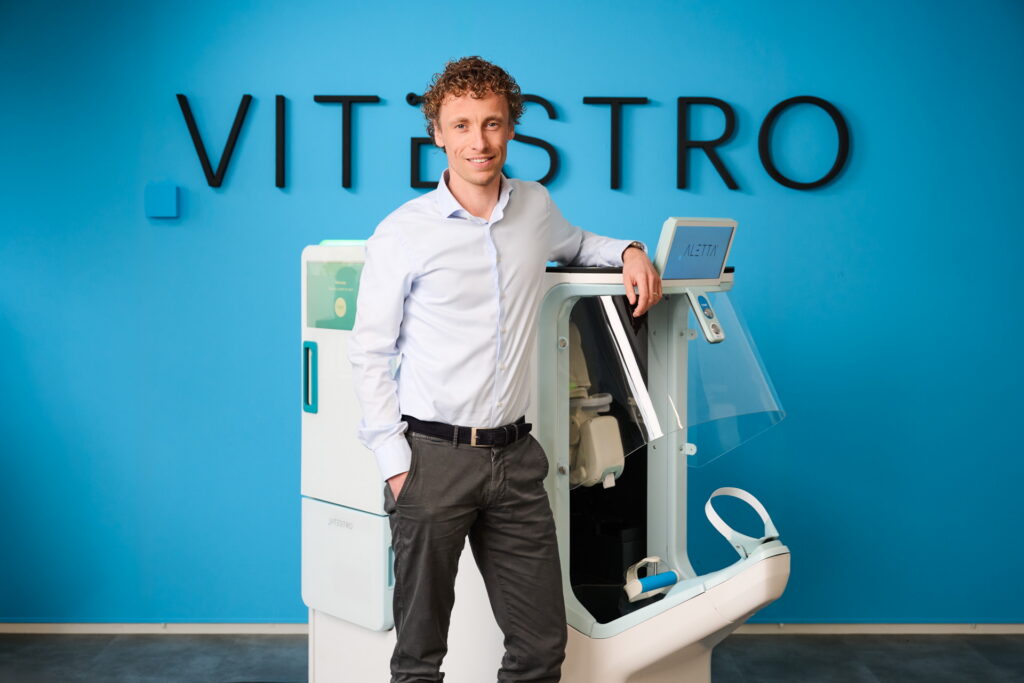
New funding will help Vitestro expand clinical validation, scale manufacturing, and prepare its autonomous blood-draw technology for broader hospital and laboratory adoption.
Vitestro has secured $70 million in oversubscribed Series B financing to accelerate development and commercialization of its Aletta Autonomous Robotic Phlebotomy Device (ARPD), a platform designed to automate routine blood collection in clinical settings.
In March 2025, The Dark Reportreported on Vitestro’s development of the ARPD—one of the last manual steps in the laboratory testing workflow. The company had recently received CE mark approval in Europe and reported clinical trial results showing a 95% first-stick success rate and strong patient acceptance, positioning the technology as a potential solution to phlebotomy staffing shortages and pre-analytical variability in clinical laboratories.
For clinical laboratory leaders facing persistent staffing shortages and rising specimen volumes, the investment highlights growing industry interest in automating one of healthcare’s most common clinical procedures.
“Closing our Series B financing reflects strong conviction in our mission to establish a new standard in autonomous robotic venous access and diagnostic blood collection,” said Toon Overbeeke, chief executive officer and co-founder of Vitestro. “Diagnostic blood collection remains the highest-volume invasive medical procedure globally, with billions of procedures performed annually.” (Photo credit: Vitestro)
Vitestro plans to use the capital to advance the next generation of its Aletta platform, conduct additional clinical studies, and scale manufacturing as the company prepares for broader commercial rollout in Europe and eventual entry into the United States through the FDA’s de novo regulatory pathway.
The Aletta system combines multimodal imaging, robotics, and artificial intelligence to autonomously identify veins, guide needle insertion, and collect blood samples with high precision. The platform is designed to perform routine diagnostic blood draws, potentially helping laboratories standardize collection quality while reducing human-dependent variability.
For laboratory executives, the technology could offer a new strategy to stabilize phlebotomy operations as workforce shortages persist. By automating routine blood draws, robotic platforms like Aletta may allow organizations to improve workflow predictability, support existing staff, and maintain patient throughput in high-volume outpatient settings.
A forthcoming issue of The Dark Report will feature interviews with Vitestro executives and provide deeper analysis of what autonomous robotic phlebotomy could mean for clinical laboratories, including its potential impact on staffing, workflow efficiency, and specimen quality.
It is just the latest development in the rapidly evolving area of Alzheimer’s research that the general public is becoming increasingly aware of. Clinical laboratory professionals should continue to monitor this progress.
The study, published in Nature Medicine, demonstrated that the predictive models could estimate the onset of Alzheimer’s symptoms within a margin of roughly three to four years. By estimating when cognitive decline may begin, the approach could help researchers enroll patients in clinical trials at the most informative stages of disease progression, shortening study timelines and improving the evaluation of therapies designed to delay or prevent symptoms.
In September 2025, Dark Daily reported that new clinical guidelines from the Alzheimer’s Association recommend that Alzheimer’s blood tests achieve at least 90% sensitivity and specificity before they can replace established diagnostic tools such as amyloid PET imaging or cerebrospinal fluid testing. The recommendations aim to standardize clinical use of emerging biomarkers—particularly p-tau and amyloid-beta assays—while helping clinicians and laboratories determine when blood-based tests can be used for diagnosis or as triage tools in Alzheimer’s disease evaluation.
Blood Biomarker p-tau217 Provides Early Clock for Alzheimer’s Disease Progression
Alzheimer’s disease currently affects more than seven million Americans, and the economic burden continues to grow. According to the Alzheimer’s Association, health and long-term care costs related to Alzheimer’s and other forms of dementia are projected to reach nearly $400 billion in 2025. Because symptoms often appear years after underlying brain changes begin, researchers have increasingly focused on identifying biomarkers that can detect and track disease earlier.
The new predictive models rely on measuring plasma levels of a protein biomarker known as p-tau217, which reflects the accumulation of amyloid and tau proteins in the brain—two pathological hallmarks of Alzheimer’s disease. These misfolded proteins begin building up many years before symptoms emerge. By analyzing patterns of p-tau217 in blood samples, researchers created what they describe as a biological “clock” that tracks disease progression.
“Our work shows the feasibility of using blood tests, which are substantially cheaper and more accessible than brain imaging scans or spinal fluid tests, for predicting the onset of Alzheimer’s symptoms,” said senior author Suzanne E. Schindler, MD, PhD, an associate professor in the WashU Medicine Department of Neurology. Schindler noted that these models could allow clinical trials of potentially preventive treatments to be performed within a shorter time period.
To develop the models, investigators analyzed data from 603 older adults participating in two major longitudinal research initiatives: the WashU Knight Alzheimer Disease Research Center and the multi-site Alzheimer’s Disease Neuroimaging Initiative. Participants lived independently and were monitored over time for biomarker changes and cognitive decline.
The researchers found that elevated p-tau217 levels in blood correlated strongly with amyloid and tau buildup observed through PET brain imaging. Using this relationship, they estimated how long it typically takes for individuals with elevated biomarker levels to develop cognitive symptoms.
Age Influences Alzheimer’s Symptom Onset as Blood Biomarker Model Gains Validation
Interestingly, the timeline varied by age. Participants who first showed elevated p-tau217 at younger ages experienced longer delays before symptom onset. For example, individuals with elevated levels at age 60 tended to develop symptoms roughly 20 years later, whereas those whose biomarker levels rose at age 80 developed symptoms about 11 years later. The finding suggests that younger brains may be more resilient to the early stages of neurodegeneration.
The predictive approach also proved robust across multiple diagnostic assays measuring p-tau217, including the commercially available PrecivityAD2 blood test. Researchers noted that broader use of blood-based biomarker testing could offer a more accessible and cost-effective alternative to PET imaging or spinal fluid analysis.
For clinical laboratories and diagnostic developers, the findings highlight the growing role of blood-based biomarkers in neurodegenerative disease detection and management. While additional research will be required before such models are used in routine clinical care, investigators say the technology could significantly improve the design of preventive Alzheimer’s trials—and eventually help physicians identify patients most likely to benefit from early interventions.
This article was created with the assistance of Generative AI and has undergone editorial review before publishing.
Researchers identified distinct blood metabolite signatures that could help clinical laboratories develop noninvasive tests to detect gallbladder cancer earlier and improve diagnostic decision-making.
Metabolomics Identifies Blood Markers for Gallbladder Cancer Detection
Gallbladder cancer remains relatively rare in the United States, affecting about 12,000 people annually and causing roughly 2,000 deaths. However, the disease often carries a poor prognosis because early symptoms are minimal and screening options are limited. In some parts of the world—particularly northern India’s Assam region—the cancer is far more common and frequently diagnosed late. These factors have driven researchers to explore blood-based biomarkers that could support earlier detection and improve patient outcomes.
For laboratory professionals, the study highlights the expanding role of advanced metabolomic analysis in biomarker discovery. Investigators analyzed blood samples from three patient groups: gallbladder cancer patients without gallstones, cancer patients with gallstones, and individuals who had gallstones but no cancer. Using untargeted metabolomics, the team detected hundreds of altered metabolites—180 in gallstone-free cancer cases and 225 in gallstone-associated cases—revealing metabolic patterns that could differentiate malignant disease from benign gallstone conditions. Many of the biomarkers were linked to bile acids and amino acid derivatives associated with tumor development and progression.
A key step in translating these signals into clinically meaningful insight involved computational metabolomics.
Illinois researcher Amit Rai, an assistant professor in the Department of Crop Sciences, part of the College of Agricultural, Consumer and Environmental Sciences, emphasized the importance of careful data interpretation in large-scale biochemical studies. “Once the raw data are generated, the real challenge is making biological sense of it. Properly annotating metabolites and analyzing their patterns is what allows us to move from signals in the data to meaningful insight about disease mechanisms.”
Blood-Based Biomarkers Could Enable Earlier, Noninvasive Detection of Gallbladder Cancer
The researchers ultimately identified metabolic signatures capable of distinguishing gallbladder cancer patients with and without gallstones. According to study leader Pankaj Barah, assistant professor, Tezpur University, “Our findings show that changes in certain blood metabolites can clearly distinguish gallbladder cancer cases with and without gallstones. This raises the possibility of developing simple blood-based tests that could support earlier diagnosis.”
For clinical laboratories, such testing could eventually offer a practical, noninvasive approach to identifying gallbladder cancer before symptoms become severe. Study co-author Subhash Khanna, gastrointestinal surgeon at Swagat Super Specialty and Surgical Hospital in India, noted that “identifying blood-based metabolic markers provides a practical pathway toward earlier diagnosis and more informed clinical decision-making.”
While additional multicenter studies will be necessary before the biomarkers can be translated into routine clinical use, the research provides an important proof of concept. It also highlights how laboratory-driven disciplines—such as metabolomics, advanced analytics, and interdisciplinary collaboration—are increasingly shaping the future of cancer diagnostics.
New LinkedIn data highlights workflow optimization, compliance, and clinical laboratory testing as fast-growing skills shaping the future of lab careers.
LinkedIn’s latest “Skills on the Rise” report offers fresh insight into how the healthcare workforce is evolving—and clinical laboratory professionals are directly impacted. The ranking, based on year-over-year growth in skill acquisition and hiring success, reflects real-time labor market demand between December 2024 and November 2025.
For laboratories facing staffing shortages, reimbursement pressure, and expanding test volumes, the findings reinforce a clear message: Technical expertise alone is no longer enough.
Operational Excellence and Compliance Take Center Stage
The No. 1 fastest-growing skill, Workflow Optimization, underscores mounting pressure on labs to improve efficiency across specimen processing, documentation, scheduling, and result reporting. As automation expands and margins tighten, laboratory managers are expected to streamline operations while maintaining quality and turnaround times.
Standards Compliance (No. 4) further highlights the regulatory realities labs operate within. With ongoing scrutiny around billing practices, data privacy, and quality systems, laboratorians must be fluent in compliance frameworks and documentation standards. Strong governance is no longer confined to the quality department; it is becoming a core competency across the laboratory workforce.
Photo credit: LinkedIn
Clinical Laboratory Testing itself ranked No. 7, which signals sustained demand for professionals skilled in analyzing blood, urine, and tissue samples for disease detection and monitoring. Growth in this skill aligns with rising diagnostic utilization driven by chronic disease prevalence, aging populations, and precision medicine initiatives.
Soft skills are gaining equal weight. Cross-Functional Communication (No. 2) reflects the increasing integration of laboratories within broader health systems. Lab professionals must collaborate effectively with physicians, nurses, IT teams, and administrators to ensure accurate test utilization, minimize errors, and support value-based care goals.
The appearance of Report Preparation (No. 10) points to another expanding expectation: turning complex clinical and operational data into actionable insights. As health systems rely more heavily on laboratory metrics to guide strategic decisions, professionals who can organize and present compliant, high-quality data will hold a competitive advantage.
Taken together, the report signals a shift in how laboratory expertise is defined. Tomorrow’s most competitive lab professionals will pair strong technical knowledge with operational savvy, regulatory fluency, data literacy, and communication skills—positioning the laboratory as a strategic driver of clinical and financial performance.
High negative predictive value and real-time insights make donor-derived cell-free DNA testing a strategic addition to molecular diagnostic menus.
A new blood test that measures donor-derived cell-free DNA (dd-cfDNA) is reshaping post-transplant surveillance by offering clinical laboratories a powerful, noninvasive tool to detect organ injury earlier than traditional methods.
The assay enables physicians to monitor graft health through a blood draw—potentially reducing reliance on invasive tissue biopsies and allowing for more timely intervention. The research was outlined in a recent article published by the College of American Pathologists, “Utilizing Cell-Free DNA Technologies for Clinically Significant Biomarkers in Solid Organ Transplantation,” about the clinical application of cell-free DNA technologies in solid organ transplantation.
“This new test functions as an early warning system, providing real-time insight into transplant health using a simple blood draw,” shares co-author Julianne Szczepanski, MD, FCAP, clinical instructor, Pathology, University of Michigan Health. (Photo credit: University of Michigan Health)
For lab professionals, dd-cfDNA represents a meaningful advance in transplant diagnostics. When cells from a transplanted organ are injured—whether due to rejection, infection, or ischemia—they release fragments of donor DNA into the recipient’s bloodstream. Quantifying these fragments provides a dynamic biomarker of graft injury. In stable patients, donor-derived DNA levels remain low. Rising levels, however, may indicate early organ damage, often before clinical symptoms or traditional markers become apparent. This creates an opportunity for laboratories to deliver actionable, real-time data that directly informs patient management decisions.
The clinical utility of dd-cfDNA testing is now supported by professional guidelines for kidney and heart transplant recipients. Studies demonstrate that the assay has a strong negative predictive value, meaning low dd-cfDNA levels can reliably rule out rejection. For laboratory directors and pathologists, this is significant because the findings show that high-confidence, rule-out testing can help reduce unnecessary biopsies, lower procedural risk, and decrease healthcare costs. At the same time, elevated results can identify patients who require closer surveillance, immunosuppression adjustments, or further diagnostic workup.
Broader Use Increases Demand for Lab Expertise
Importantly, while dd-cfDNA testing is highly sensitive to graft injury, it does not always specify the underlying cause. Elevated levels may reflect rejection, infection, or other forms of tissue damage, requiring correlation with clinical findings and additional testing. This reinforces the laboratory’s role not just in generating results, but in guiding interpretation and supporting multidisciplinary transplant teams.
Ongoing research aims to expand dd-cfDNA applications beyond kidney and heart transplantation to include liver and lung recipients. Investigators are also exploring refinements that could differentiate types of organ injury, further enhancing diagnostic specificity.
For clinical laboratories, dd-cfDNA testing underscores the expanding role of molecular diagnostics in precision transplant medicine—offering a scalable, patient-centered approach to graft monitoring that aligns with broader trends toward minimally invasive, data-driven care.