

Clinical pathology laboratories will keep busy interfacing their LISs to these EMRs
Tis the season of electronic health records (EHR), now that both hospitals and physicians can qualify to earn incentives from the federal government when they implement these solutions and meet “meaningful use” criteria.
It is possible for individual hospitals to receive incentives totaling as much as $2 million for implementing a certified EHR. This is powerful motivation for cash-strapped hospitals. For that reason, pathologists and clinical laboratory managers of hospital laboratories can expect to be busy ensuring that their laboratory information system (LIS) interfaces properly with the EMR of their parent hospital.
It will be a huge undertaking. Early reports indicate that only a fraction of the nation’s 4,749 acute-care hospitals have implemented an EHR that meets the ARRA legislation’s “meaningful use” clause.
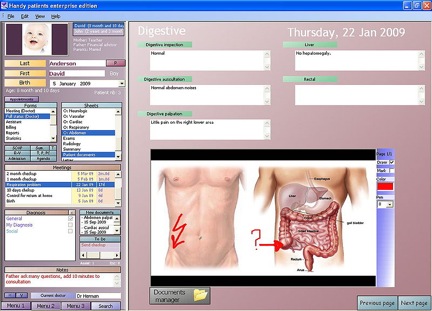
(Example of a functioning electronic medical record. Sourced from Wikipedia.)
According to an August 2010 article published in Health Affairs titled “A Progress Report on Electronic Health Records in U.S. Hospitals,” though installation of basic EHR systems rose slightly from 8.7% in 2008 to 11.9% in 2009, only 2% of America’s hospitals have implemented an EHR that could accomplish meaningful use and qualify for the incentive funds.
Nevertheless, the number of installations is growing, and will probably accelerate, due to an increasing number of physicians using EHRs. Dark Daily recently reported on this trend in “Hospital and Physician Adoption of EHRs Will Accelerate Because of Federal Incentives.”
According to the National Center for Health Statistics (NCHS), the number of physicians using any type of EHR doubled between 2006 and 2010, and those using fully functional EHRs nearly tripled.
Ranking of Hospital EMR Installations by Vendor
This list was compiled from the HIMSS Analytics Database, and reported in Modern Healthcare.
The counts are based on systems installations between February 2010 and February 2011 that are:
• live and operating,
• in the process of being installed,
• contracted but not yet installed.
| Vendor Name
|
Total Installations | Percent of Installations |
| • Meditech | 1212 | 25.5% |
| • Cerner | 606 | 12.8% |
| • McKesson | 573 | 12.1% |
| • Epic Systems | 413 | 8.7% |
| • Siemens Healthcare | 397 | 8.4% |
| • CPSI | 392 | 8.3% |
| • Healthcare Management Systems | 347 | 7.3% |
| • Self-developed | 273 | 5.8% |
| • Healthland | 223 | 4.7% |
| • Eclipsys (Bought by Allscripts) | 185 | 3.9% |
| The list is free and can be downloaded by clicking here. | ||
Medical laboratory administrators will find it interesting to note that just three healthcare IT companies control more than 50% of the hospital EMR market. Between them, Meditech, Cerner Corporation, and McKesson hold a collective 50.4% of hospital EMR installations, based on the HIMSS Analytics Database.
Of course, hospitals are not the only class of provider working to implement EMRs. Office-based physicians can qualify for federal incentives, and this year alone it is predicted that as many as 60,000 physicians will begin EMR implementations during 2011. This places a strain on the clinical laboratories and pathology groups that are asked to create interfaces between their LISs and the clients’ EMRs.
—Michael McBride
Related Information:
Top vendors of enterprise EMR systems: Modern Healthcare
A Progress Report on Electronic Health Records in U.S. Hospitals: Health Affairs

I have worked with Meditech, Cerner, and am familiar with Epic. By far, Meditech is the best! Their support staff is unbelievable. I have taught Meditech training for 22 years. It is extremely user friendly. You are able to customize your version of Meditech and I really like that part. You get what you put into it.
EPIC is a load of government horse garbage.
Hello,
I am surprised that Epic was ranked as number 4 in your list , you might want to reevaluate it because it is already end of 2014 and I think Epic would have definitely more installation than Mckesson.
Have been an office implementation manager twice. I like technology. I like EMR – in general. When HIE comes, we will all benefit. That said – Meditech is BS. It promotes fragmented care and is a rate limiting step to healthcare (benefit to CMS I am sure). As a provider I recommend you look elsewhere – If this is the best there is get a chisel and a rock or maybe a fleet of scroll carrying pigeons….Danger Will Robinson, Danger!
What about eClinicalworks EMR company. Can you give us some knowledge about it’s EMR software and how much market it has captured?
I agree with CW. Epic is the best in the business. They pick you, you can’t just buy them. It is very in depth and complicated to build, somewhat overbearing for end users at first, but honestly, I’ve used it before at one of the best hospitals in the nation. If my smaller, more rural hospital (but growing 300+ beds now) can effectively use the system, I’m sold. The greatest problem is user backlash-specifically physicians. They have been “carried” for 50 years and they just don’t want to give in. However, they need to suck it up. It’s everywhere-they can’t avoid it. They need to take responsibility for their job. It’s law now. EHR’s are all great, they are all, in there simplest form, helping patient safety, experience, convenience, and overall healthcare experience. We just all need to embrace them, and dive it. They aren’t going away,only getting bigger.
I am a RN who has worked with both the Cerner and Meditech platforms. I have found that Cerner is more streamlined and user friendly. Meditech requires me to navigate through a host of screens to get to the data entry point and loading time after each click feels like forever. Also, frequently physicians cannot enter orders they desire and will have to come and verbally explain what their order entry meant. I am well trained on both systems and find that all though they have provided multiple benefits, they certainly don’t have the ease of operation as say my iPhone! We need to get those techno gurus to create us an EMR. I believe we would all be a little less frustrated
I could not disagree with G.L. more. Coming form a computer background before and during medical school, I can say without hesitation that MEDITECH is one of the most user Unfriendly EHRs out there. Especially since CPOE has been added. Worst GUI I’ve seen in years. An amazing number of mouse clicks are unavoidable no matter how much practice or training you have. This will be the reason that I leave my current hospitalist position.
This list can be misleading at about the largest used EMR when only looking at the number of installations. I recently heard a statistic at a presentation that 50% of all patients on a given day are seen by en Epic Systems EMR. Epic systems only works with large healthcare systems (400 beds or more) and does not go after smaller clinics or health systems. There are exceptions that they work with smaller systems (such as all other hospitals in geographical area are on Epic so to facilitate better patient information exchange they will let smaller hospital use it system). It would be more useful to see statistics on utilization of a system (per patient, per bed, sometime thing) then just number of installs. Two small clinics implementing one EMR does not mean that it is more used when compared to one implementation at a large health system.
I agree with G.L that mostly its user knowledge that leads to applications not being properly utilized. However there is software that can help with knowledge transfer and end user adoption. It allows capture of procedures and generates documents or simulations for training. These docs, cue cards can also be used for live support with a click of a button it shows contextual knowledge.
Honda and MediTech a great example! Stability, UXA (User Experience Attitude) is a critical part of implementation. Revenue Cycle Modeling, all levels of the cascade of titles are impacted by strapped reimbursements, an effort to build an ACO model as hospitals pool staff based from RCF (Revenue Cycle Forecasting). RCF is a foreshadow, based from cloud EDI transactions, 270/271s which may offer suggestions to Drs, as 835/837s aggregate, BioInformatics, familial modeling, disease modeling, in RTL (Real Time Logistics-POC)…implementation of EHR/EMR is just the end of the beginning…
Benjamin & D.S. – it is clear you both are quite misinformed. Benjamin – the reason there are so many Honda Accords on the road is because they are the most reliable car on the market – tremendous value & ROI. The same can be said for MEDITECH…hence today’s most sites attesting to Stage 1. And D.S. its clear you either do not use MEDITECH’s latest platform, which is considered by Top CMIO’s to be the most user-friendly system and most efficient… or you just require training. 90% of the time its user knowledge…not system issues.
I’m dismayed that Meditech is on top for number of installations. The system is cumbersome, not user friendly, and extremely time consuming. It would not be my choice!
Jr makes a valid point but all hardware in time will fail. The back facilities and how fast you get back in operation is imperative to your success to run your office.
Having a 3rd party support for both hardware and software could solve the issues. They are dedicated to your survival.
Also hospitals are trying to control Doctors, the 3rd party solves this as well.
While the EMR is progressing at my network of hospitals, there is still a vile resistance of physician staff and hospital staff to utilize the EMR, eventhough it is one of the most user friendly to operate. The downsides to the EMR: reduction in force. This is a financial “plus”; however, if the system goes down for reasons ranging from system failure (servers, hardware, etc) to computer viruses–nothing is completely fail-safe in a web-based platform–then things must revert to paper until the issue is fixed/repaired. So in regards to reduction in force due to technological advancement they cannot “cut their nose off to spite their face”, so to speak when eliminating all medical records staff.
Our hospital network is currently moving into a stage 5 of 6 and it is “crunch time”; however, many of the physicians are still kicking and screaming and (after 6 years of the EMR system) still refuse to utilize what they’ve been given. What are they going to do when Medical Records Dept. is no longer? And that reality in my hospital network is coming true as of now. There will be zero Medical Records Dept on site at any hospital. This is your future of the advancement of the EMR. My best advice: Docs, it’s sink or swim time and to my fellow co-workers: even if you’re a coder, the program for auto-coding physician orders is here. All that time/money and testing you spent learning ICD9 and ICD10 coding will make you furious.
Good luck with the EMR of your choice, but do keep in mind, systems fail and if you have not retained any staff that is knowledgeable and trained to handle paper charts when there is a system failure, you are in trouble. Especially in a hospital setting and especially if the system is down for 3 weeks, as it was for us a couple years back. Don’t believe the hype that this is an end-all/be-all solution with the EMR. Stuff happens. Be prepared.
Saint Vincents is using Allscripts, if you value your life go elsewhere.
It’s exciting to see the progression of electronic medical records.
Sadly, the number of installations has no correlation to how competent an EMR can do their job. What will be a more interesting statistic is to see the percentage of those site, by vendor, who met ARRA Meaningful use. I’ve bet if you look at the 2% of hospitals that have already met Meaningful use, the Vendor will be totally different.
Another important element that ARRA does not evaluate is the usability of an EHR, having the data available in the system does not mean provder can use them as information in a clinical setting.