Recruiters should target five personas for hiring new talent and retaining existing staff, McKinsey says, a goal that would be challenging for clinical laboratories recruiting medical technologists
Clinical laboratories and pathology groups continue to struggle filling vacated positions with new hires and retaining adequate staff due to what has been dubbed the “Great Resignation.” The ongoing, pandemic-era phenomenon is seeing people leave their jobs in mass exodus and remains a characteristic of the 2022 labor market.
According to the US Department of Labor, 4.3 million people quit their jobs in January of this year. Of equal significance for hospital and health system medical laboratories with shrinking budgets, compensation rates are increasing for these positions at a steady pace.
This international economic trend continues to affect businesses across the country as workers leave their jobs in record numbers. Especially hard hit are hospitals and clinical laboratories, and recruiters seem at a loss as to what can be done to turn it around.
“This isn’t just a passing trend, or a pandemic-related change to the labor market,” Bonnie Dowling (above), Associate Partner at McKinsey, told CNBC. “There’s been a fundamental shift in workers’ mentality, and their willingness to prioritize other things in their life beyond whatever job they hold. We’re never going back to how things were in 2019.” Clinical laboratory recruiters can attest to that statement as they continue to struggle to fill open positions and maintain staffing levels. (Photo copyright: McKinsey and Company.)
Workers Are Unhappy and Unsatisfied
For their report, McKinsey surveyed more than 12,000 workers located in the United States, Canada, United Kingdom, Australia, India, and Singapore to determine why they are resigning and what factors would sway them to remain in their positions.
Their findings suggest that 40% of the people in the workforce are unhappy and unsatisfied in their current jobs and are seeking better, more fulfilling employment opportunities. Among those workers who have recently resigned from a job, 41% said lack of opportunity for upward mobility and no pay or benefits was the top reason they quit.
The McKinsey analysts noted certain repetitive occurrences during the past year they attributed to the Great Resignation, which McKinsey calls the Great Attrition:
Reshuffling: Workers are resigning and taking positions in other industries, which is causing some industries to disproportionately lose talent.
Reinventing: Workers are vacating traditional employment and choosing nontraditional roles, such as temporary, gig, part-time work, or they are opting to start their own businesses.
Reassessing: Workers are leaving the workforce entirely to focus on other priorities, such as taking care of children or relatives, concentrating on self-care, or pursuing other interests.
Recruiters Should Focus on Five Unique Personas
As of June 30, there were 10.7 million job openings in the US, according to US Bureau of Labor statistics. And some industries, such as healthcare, are losing talent to other industries.
Among surveyed individuals who quit their jobs between April 2020 and April 2022 in the healthcare and pharmaceutical industries, 54% accepted a position within another industry or did not return to the workforce, according to McKinsey analysts.
The McKinsey report urges hiring managers to focus on five unique personas in their efforts to target and hire desired talent, and retain them as employees:
Traditionalists: Career-oriented individuals who are the mainstay of the classic labor pool. They are easier to find through common recruitment strategies, according to McKinsey, and are motivated by compensation, benefits, job titles, status, and opportunities for career advancement.
Do-it-yourselfers: These workers are typically 25 to 45 years old and value flexibility above all else when choosing jobs. They want autonomy to establish their own hours and the type of duties they will perform. This includes gig, part-time, and self-employed workers as well as full-time employees in nontraditional roles.
Caregivers: Workers who are at home due to other priorities, but who may be looking for an opportunity to re-enter the workforce. People in this group desire companies that are willing to work around their personal schedules. They could be coaxed back into the labor force with part-time options, four-day work weeks, flexible hours, and work-at-home positions.
Idealists: These workers tend to be in the 18- to 24-year-old age range, may be working part-time, or may still be students. These individuals value being part of a community and are most easily swayed by companies that have a strong organizational culture with an emphasis on meaning and purpose.
Relaxers: People who are not looking for work, but who could be convinced to return to the labor force under ideal circumstances. This group is mostly comprised of early- and natural-age retirees who still have productive years left. They represent the largest percentage of the latent workforce, McKinsey noted. Companies should consider seeking out these seasoned workers who may be more interested in meaningful work than a big paycheck.
“More employers have opened up their aperture in order to meet the yawning talent gap that they’re facing,” said Bonnie Dowling, Associate Partner at McKinsey and one of the authors of the report in an interview with CNBC. “They’re prioritizing skills over educational background or previous job experience, which is creating more opportunities across sectors for job-seekers.”
Four Strategies for Retaining Workers
Finally, the McKinsey report offered four strategies that companies can focus on to retain their existing talent and avoid resignations:
Sharpen traditional employee value status through compensation, benefits, career advancement potential, reputable job titles, and the overall prestige of the organization.
Build creative, nontraditional, value propositions revolving around flexibility, a strong company culture, and more personalized methods of career progression.
Expand and tailor talent-seeking approaches to woo nontraditional workers.
Invest in more meaning and belonging in the company’s culture to build stronger teams and relationships among workers.
“It’s everything from embedding flexibility in our credo to reassessing how we value our employees and provide them with the resources they need to do their job. All employers have the capacity to make these meaningful changes,” Dowling said. “But we have to start taking action, as opposed to sitting back and hoping that things are going to return to a ‘pre-pandemic norm’ because all signs point to the fact that they won’t.”
The ongoing labor shortage is affecting many industries, but it has been especially hard on healthcare and clinical laboratories.
Clinical laboratory recruiters may want to begin looking at the shifting economic scene in the US as an opportunity to restructure workplaces and create a better model to avoid resignations and retain workers.
Labs need to rethink recruitment tactics to successfully hire younger workers
We’ve heard a lot anecdotally about the “Great Resignation”—a labor phenomenon rooted in the pandemic that has led to an abnormally large amount of workers, including lab professionals, quitting their jobs.
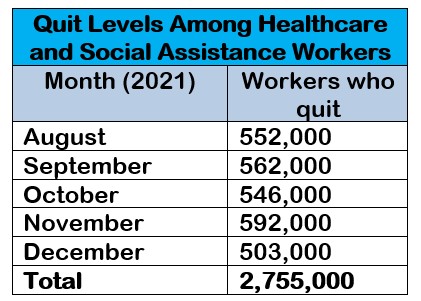
The trend has hit healthcare hard, as evidenced by the latest numbers from the U.S. Bureau of Labor Statistics. From August 2021 through December 2021, the healthcare and social assistance workforce saw nearly 2.8 million workers quit—an average of 551,000 people each of those months. By comparison, in December 2020, 419,000 healthcare workers left their jobs.
Nearly 2.8 million healthcare and social workers quit their jobs from August through December 2021. Source: Bureau of Labor Statistics.
Anxiety from the pandemic is likely a contributing factor to some job departures. However, in clinical labs, other causes also are behind the abundance of open positions, such as early retirements, graduating individuals experiencing more specialized training programs, and a shift in the way the current working generation views employment, said Tara Luellen, Vice President of Laboratory Director Services at consulting and recruiting firm Lighthouse Lab Services.
“The lab industry has been hurt at the greatest extreme from this Great Resignation just in terms of the dire need for lab roles and the small pool of correctly qualified individuals in many instances,” particularly with COVID-19 testing demand, she noted.
Specialized Laboratory Roles Cramp Further Development for New Hires
Luellen explained that the labor shortage problem is exacerbated because fewer new lab technologists and pathologists are entering the field at the same time that many lab professionals are quitting.
Additionally, younger workers that do go into the clinical lab and pathology industry tend to be trained in specialty areas more so now than the broader training programs of the past.
“We don’t have as many individuals who are more broadly trained; instead, they’re very specialized,” she added. “So, it takes them years working at labs that do a variety of things to gain real-life, hands-on experience with other kinds of testing than that included in their specialty program, in many cases.”
“We don’t have as many individuals who are more broadly trained,” said Tara Luelllen.
‘They Want to Experience a Community at Work’
For clinical labs and pathology groups looking to fill open roles, it may be time to take action beyond just beefing up salaries.
Instead, look at what motivates lab professionals to come to an organization, Luellen suggested. She’ll explore the topic of how to successfully recruit new clinical lab leaders in further detail at her session during the 2022 Executive War College on April 27-28 in New Orleans.
One piece of advice she offered is for lab recruiters to carefully articulate to job candidates how an open lab director position or similar role may contribute to either the local or medical community. It’s also important to explain what type of culture an organization offers new employees.
“What we’re seeing is a big shift in what people are looking for,” Luellen said. “The compensation still has to be there, but it’s also a whole community that these people are looking for.
“They’re looking for more than just a 9 to 5, punch the clock, and go home gig,” she continued. “They want the job to enrich their lives. They want to experience a community at work. It’s a different paradigm in how they look at what work means for them.”
Brief Corporate History Slone Partners was founded in 2000 by Adam Slone. Adam recognized that the clinical laboratory industry was in need of search services that had a profound understanding of the nuances within this industry. Today, Slone Partners is a national search firm that provides a customized and expedient search process to clients that are committed to identifying and recruiting top talent. As the industry is expecting rapid developments in testing capabilities and the acceleration of the aging population continues, Slone Partners is well prepared to provide quality service to its rapidly growing clients that are seeking exceptional talent.
Short Bio on Principal Officers and Consultants
Adam Slone, CEO In 2000, Adam founded Slone Partners, one of the first executive recruitment firms specializing in the diagnostic and laboratory testing industries. After a decade of successful business development experience in the diagnostic laboratory industry, Adam recognized that his in-depth knowledge of this complex industry was necessary to help companies compete for talent. His industry knowledge and extensive contact base enabled Slone Partners to successfully place hundreds of professionals with clients in its first years of operation.
As the needs of the diagnostic and laboratory testing industries evolved, so did Slone Partners. In 2007, Slone Partners expanded its service offerings to include a comprehensive set of services, recognizing its clients’ desire to build and develop the skill set of its internal talent pool.
Adam holds a Bachelor of Science degree in Finance from Old Dominion University. Adam speaks regularly at some of the industry’s largest conferences.
Tara Kochis, Executive Vice President & Partner
Tara joined Slone Partners in 2004. She brings over a decade of solid healthcare experience to the company and she was consistently ranked as one of the top producing sales representatives with industry leaders such as VERSYSS, American Medical Laboratories and Quest Diagnostics. Her highly successful, award-winning sales career covered a wide variety of healthcare segments, including information technology, medical records and most importantly, the diagnostic and laboratory testing industries.
Prior to healthcare, Tara honed her recruitment skills in the banking and finance sector, expertly filling a wide variety of financial positions.
Tara’s executive recruitment skills, coupled with her extensive healthcare background, helps her quickly and accurately assess candidates for the benefit of Slone Partners’ clients. Her orientation towards action and persistence helps keep client searches moving towards completion. Tara graduated cum laude, receiving a Bachelor of Science, with a concentration in Human Resources Management, from Boston College. She is an active member of AACC, ACHE and CLMA.
Our work and clients are confidential. Our clients include smaller to mid size routine and esoteric laboratories. Approximately forty percent of our clients today are molecular and anatomic pathology laboratories. Our assignments range from building sales teams to building senior management teams.